
TAKE TWO - 6 April 2026

End of Cycle Three and The Plan - The previous update stated that commencing with the next chemotherapy cycle - Cycle Three or
the one this report covers - I would likely change the reporting scheme. Rather than share the bits and pieces of each and every day -
although those would still be logged for later reference - each update would, instead, give a summary of the whole cycle. The
introduction concluded that the next update would then follow in the week of March 11. Since this is approaching a month later, it might
properly be concluded that something did not go according to plan. That was the case.
Cycle Three Commences - Each cycle commences with the same steps, which feature three primary drugs. Two of these are, simply
put, poisons that are delivered as an infusion through the vein port implanted in Gloria’s left upper-chest wall. Carboplatin is one
drug and Taxotere is the other. These are chemicals that block the normal functioning of all cells when they try to reproduce. These
chemicals have a comparatively short "half life." This term refers to the length of time after an infusion that the amount in the
blood stream drops from its peak value to one half of its peak value. For Taxotere, that value is about 16 hours. For Carboplatin,
it is about 5 days.
Cells that reproduce fairly quickly will be hit the hardest by these chemicals as they will still be at a high concentration. These
include rapidly-growing cancers as well as other quickly-dividing cells, such as those of the food tract and hair.
In contrast, these chemicals have little impact on cells that do not reproduce frequently, such as those of the bones and nervous
system.
The basis for the treatment is that normal cells with good DNA have more robust damage-response mechanisms than do cancer cells.
The third drug is composed of two elements given as a single shot. Unlike the blunt-hammer approach of the poisons, Phesgo focuses on
cells that use the activation of the HER2 receptor as a signal to commence reproduction. Gloria's cancer is - or was - of this type.
One chemical in Phesgo blocks cells with this receptor type from allowing the receptor to react to estrogen molecules in the blood
stream to initiate a reproduction cycle. The other drug also works on cells with such a receptor, but triggers a reaction that leads
to the cell committing suicide.
The Phesgo drugs have a half life of about 25 days, so are still quite active by the time another treatment cycle typically commences.
So while the first two are present and then largely vanish, the Phesgo components remain long enough that the next cycle sort of
"tops up" what remains from the previous one.
The additional drugs given counteract side effects from these three. A couple suppress reactions to the poisons that would trigger
nausea. The poisons also tend to kill off blood cells, so an injection is given the day after the infusions that stimulates the bones
to produce more.
Cycle Three followed the pattern of previous cycles with one small exception. Sustol is an anti-nausea drug that was injected into
the fat of her belly. It formed a small lump that slowly was absorbed.
That happened, but slower than expected, so after the first two cycles, she had two "bumps" remaining. So for Cycle Three, Posfrea
was used instead and administered by her IV line.
Typical Cycle Progression - By the third cycle, the pattern was clear. The two days following the infusions were generally of
little note. But on the third day, there was a significant decline in appetite, perhaps due to the fact that the intestines were
quite unhappy campers. Diarrhea was a constant companion as was lethargy. This was at its worst about five days after the infusion,
followed by a slow climb out of this phase.
Gloria’s Particular Susceptibility - Diarrhea is a natural outcome for most patients as the poisons disturb the fast-dividing
intestinal cells. The associated cramping then puts a dent in the desire to eat, making weight loss a normal companion of this sort
of chemotherapy.
But Gloria has always had a somewhat sensitive digestive system, something she probably comes by naturally as there is a bit of
history of it on her mother's side. When combined with the fact that she does not gain weight easily, the treatments are particularly
effective at causing her to lose weight. Studies consider a 10% loss after six cycles of chemotherapy to be an upper extreme, a level
about 30% of patients experience. For Gloria, this would equate to about 13 lbs.
A few days into Cycle Three, Gloria had already lost 20 lbs. Neither the oncologist nor her family doctor were comfortable with
seeing her lose any additional.
Linda, Gloria's cousin on her mother's side, had the misfortune of having endometrial cancer and she too lost a considerable amount
of weight - 40 lbs. But she was not as slender as Gloria is, so the loss wasn't quite as important, although still dramatic.
Not an Exact Science - Gloria was signing some papers a while back and laughed when she saw one of the informational
"bullets." It stated that medicine is not an exact science and hoped-for outcomes are just that, goals without any guarantee they
will be reached.
One of those "hopes" was Gloria's weight loss would stop, but even with her drinking protein drinks and forcing herself to eat, she
continued to lose. As the trajectory became clear, I told Gloria that it was my recommendation she stop treatments until she regained
5-to-7 lbs - the approximate amount she was losing per cycle. That met with a mixed reaction. She wasn't sure how she felt departing
from Dr. Koeneke's plan-of-action, yet also seemed relieved as she was feeling pretty weak.
Four Versus Six Cycles - As the "exact science" statement implied, unlike the design of a building or the manufacture of a
television set, medicine, as often as not, is built on trial and error. If something is tried and the results are positive, it often
becomes the go-to therapy with no way of knowing if some other arrangement would be better or worse. This is because the "system" is
not really receptive to adjustment. New trials cost money. It also exposes researchers to lawsuits that assert that they are
departing from the "established" methods, even when that established method may have little more than history to support it. Drug
suppliers also have little interest in therapies that reduce the amounts used.
In general, some outside pressure is needed to prompt new studies that alter treatment regimens. When Gloria was receiving radiation
for her 2022 cancer, the recent standard had been 20 doses. But the number of expensive machines was too small to meet the number of
cancers being detected. That prompted trials of a 16-correspondingly-higher-dose therapy. It proved as effective as the 20-dose
regimen. So by the time of Gloria's treatments, the recommended number had been reduced to 16.
While a regimen of six cycles of chemotherapy has been the recent standard for women in Gloria's current situation, there has been
pressure building to shift to four. It arose from two sources. One was a concern over the long-term damage caused by the poisons. The
second was much like the radiation therapy scenario - would a reduction in treatment number have a disproportionate increase in bad
outcomes or not?
Several large studies have been published in 2023 and later addressing these concerns. It appears that reducing the number of cycles
from six to four increases the number of woman who suffer a relapse by one in a hundred. Yet as many as a third of the women appear
to be "aged" by those treatments by an amount somewhere between 5 and 15 years.
If these assessments are true, what would that mean for 200 65-year-old women with early-stage breast cancer and subjecting 100 to
four cycles and the second 100 to six? At the end of five years - the normal "finish line" for measuring cancer-treatment success -
3 out of the first hundred will suffer a relapse, while the second group will have had 2 relapse.
But at the end of 5 years, the first group's 97 cancer-free women may live the normally expected 17.5 years, whereas the second
group's 98 may only average 12.5 to 16 years. Putting it another way, six cycles mean more will reach the 5-year mark, but a greater
number will die younger due to premature aging.
It should be noted that there is a certain amount of apples-and-oranges occurring here. While cancer-treatment success is measured in
terms of number of women living cancer free at the end of five years, a reduction in life expectancy is measured by age at death.
While there is a need for setting unequivocal mileposts by which to compare outcomes, those may ignore individual circumstances. One
of the side effects of the current treatment regimen for some patients is a reduction in leg-muscle strength and balance, probably
due to neuropathy. These could well trigger a change from independent living to residing in a care facility. Dr. Doering once
mentioned that he frequently has patients who state a goal of living to an age of 100. He wondered how many of those would say that
if they really considered what the life of the average centenarian looks like day-to-day.
An example of how difficult research in this area can be lies in the data available. In the past, women who died during treatment
were registered as dying of breast cancer as that was why they were undergoing treatment. But looking more closely at how they died
suggests that 1-to-2 percent of those deaths were not a direct result of the cancer, but due to an adverse reaction to the therapy
for their cancer!
The Letter and a Surprise - With Gloria's encouragement, I composed a letter to Dr. Koeneke, the thrust of which was to
suggest Gloria be allowed to regain some weight before commencing on Cycle Four and when she completes it, declare it the "finish
line."
But we were surprised at our next meeting to hear his suggestion to call Cycle Three "good enough," and in the future, Gloria would
continue with just the Phesgo - the normal long-term suppression therapy following six cycles.
The question might be asked why Koeneke did not initiate this discussion earlier. It should be noted that this was only the second
time we've met since the therapy sessions began due to the intervention of Christmas and other factors. In addition, the research
from UCLA’s school of medicine concerning long-term effects was not published until 2025, after the time Gloria's original plan was
proposed.
An Unfortunate Oversight - Staying fully informed on developments in Gloria's medical journey means she has been in a good
place to choose the course that matches her wishes. Part of that has involved collecting all of her pathology reports. However,
knowing we have been doing that may have led to one report item "falling through the cracks." How did that happen and what are the
implications?
The posted update for September 23, 2025, included the period when the initial right-breast-surgery pathology report was generated.
My posting included the following:
Despite the initial imaging showing only a 2 mm area and Doering taking more than that, the margins were not clear, indicating it has spread further along the ducts in all directions. A node also showed some cancer present. So it has spread beyond the breast - although the amount was low, so possibly no further than those nodes.
The information in the pathology report implied that more surgery would be called for with a chemotherapy follow-up.
But there was a bit more and neither of us can remember if Dr. Doering mentioned it. We do know the focus that day was on the
immediate need for an additional surgery. So much so, that we were distracted and left his office without obtaining a copy of the
pathology report. The consequence was an important line in it regarding the under-arm sentinel node biopsy was either overlooked
by everyone or did not register with us. It included the following phrase: Extra-Nodal Extension Present.
We left his office with the knowledge that cancer had been found in only one node and while that doesn't guarantee it had gone no
further, it pointed in that direction. The node's removal well may have been the extent of the spread. But that short phrase meant
the cancer had ALSO been found outside the node. Not only was chemo then called for, but localized radiation would be a prudent later
step.
This oversight meant we were completely surprised when Dr. Koeneke mentioned that with the Carboplatin and Taxotere infusions over,
it was time to see Dr. Bell - the radiation oncologist Gloria had seen in 2022.
I subsequently obtained a copy of the missing pathology report. Koeneke was correct and so we scheduled a visit with Dr. Bell for
March 17.
Visit With Dr. Bell - The concern with the "Extra-Nodal Extension" is there could have been additional cancer cells in the
near vicinity and a little "beat down" of the area via radiation in that territory might be effective.
A few words from Gloria's 2022 cancer update serves as a good review.
The radiation absorbed is measured in Gray units and she will get 50 total. If you are like me, that doesn't mean much. Converting
that to something more familiar, that is the amount of energy every square inch of your exposed body receives from the sun in 30
seconds on a clear day.
Gee, that doesn't sound like much.
But all radiation energy doesn't have the same effect. Sunlight is much-lower-frequency radiation than the X-rays she will receive.
Sunlight does not penetrate the way X-rays do. So it takes much more sunlight to cause the equivalent amount of cell damage and that
damage is much more superficial. A person bathed in X-rays with the same energy level as sunlight would only require about 8 minutes
to be fatal!
Gloria's total exposure this time will be closer to 40 Gray as the whole area near the original site was removed during the
mastectomy.
Brenda Avery was working as Bell's Physician Assistant in 2022. She has since retired, but he had recently asked her to pitch in to
sub for one of the nurses and Brenda was the one chosen to brief us on the suggested treatment. She gave an overview, most of it
being very similar to the 2022 briefing. She did, however, surprise us when she said the standard protocol would be 30 sessions -
six weeks at five-per-week.
Later, when we spoke about specifics with Dr. Bell, he said it would be 15 total treatments. This was yet another example where
levels twice as high given for half the time have been shown to be equally effective. In other words, this was another example of
how medicine is forced into a trial-and-error mode to develop therapy regimens.
Like last time, Gloria would have four dots tattooed on her upper torso to serve as reference markers. These are used with four
lines generated by the Linac - Linear Accelerator - which also produces the radiation. Aligning the dots with the laser lines assures
she is always situated in precisely the same position as the previous time. While she still has the tattoos from 2022, the radiation
this time will be done with her lying on her back instead, so new tattoos were required.
In addition, she would need a CAT scan to precisely locate where her internal organs are located.
These preparatory steps were completed on Friday, March 20, during an 8:45 a.m. appointment. Regular treatments will be at 11:15
a.m., weekdays, commencing April 23.
I will not repeat here the discussion of how radiation treatments work, the particulars concerning how the machine generates the
X-rays, and so on. These subjects were discussed during Gloria’s previous breast cancer adventure and the details can be found
starting here.

Enjoyed Red Hot Chilli Pipers
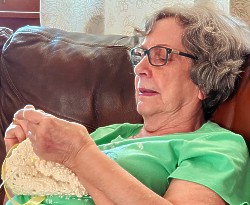
Ann F. makes Big G a topper
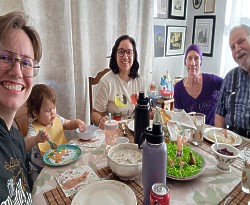
Watching DQ toe tasting

Big G loves her Red Lobster
Update Wrap-up - On March 25, Gloria had her fourth Phesgo shot. I consider that event as marking the end of Cycle
Three. Consequently, items from after that date will be included in a later update addition.
She has, in general, been getting "perkier" as each day passes and her weight loss appears to have stopped, even inching upward
a bit. Her head has gone from being as smooth as the proverbial billiard ball to now having a distinctly peach-fuzz nature.
While individual strands may be as long as a half inch, each is much finer than before, with the effect approaching the feel of
something approaching velvet.
Her appetite has increased dramatically and more and more food tastes "normal."
We have now made various plans and, assuming they come to pass, how they unfold will be documented as they do. But since those
plans have been made during this update period, it seems appropriate to mention them here:
» Trip to Appleton - One day we drove to Topeka to generate some photos for a story I was working on. We also stopped at
the Red Lobster - a Gloria personal favorite - for supper. At some point not long after, she remarked that trip was the farthest
she had been from home since last September.
It was, I believe, an expression of her having a touch of cabin fever. Having seen this coming, I had taken steps some time
ago to fly to Appleton - my hometown - and spend about two weeks there before returning, all to produce a needed change of
scenery.
However, while the Topeka trip was a modest one, we were very glad we went because not long after, it was announced the Red
Lobster location is being closed April 15.
» On April 16, our "adopted German son" Tim will arrive for several-day visit, just because!
» On May 27, we will fly to Manchester, England and then drive to Llanrhaeadr-ym-Mochnant in Wales, where we will stay
with friends/family Lins, Dave, Owain and John Vaughan until late June.
The treatment plan is to continue with the approximately every-three-week Phesgo shots. Barring something dramatic happening, I'm
considering the next update to be near the end of May.
In the past, I have posted day-to-day happenings for later reference. I am continuing that log, but will not post it here or in
the future.
As before, my introverted, yet social wife, always enjoys hearing from people, so texts, phone calls and visits are always
welcome ... well, usually welcome. She does rather cherish a nap now and again and her "day" usually has a 10 a.m. starting
time. Then there are those occasions when she slips out to see granddaughter Diana or run some other errand. This means a call
before a potential visit would be prudent.
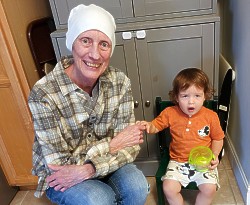
"GG" and Diana "connect"
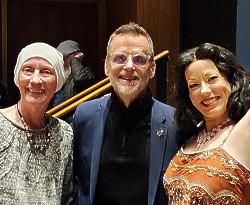
Hedy Lamarr show at McCain
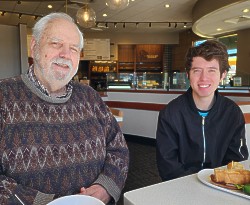
Panera lunch with friend Christopher G.
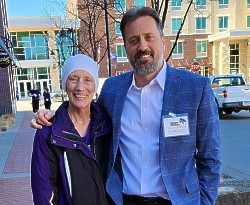
Meeting nephew Paul for lunch