
TAKE ONE - 2 July 2022

Not Binary, Lump vs. Mast, Her First Tattoo
Non-Binary - The 1997 movie "As Good as it Gets" is about a collection of people who all have various issues that limit their ability to completely enjoy life, including getting along with each other. Jack Nicholson and Helen Hunt starred and both of those talented actors won Oscars.
But I have a hunch that the movie's popularity also had something to do with the average moviegoer seeing a bit of herself or
himself in the various oddball characters. It reminds me of a pillow presented as a bit of a gag gift from a cousin. The fact that
there are tons of items advertised on the web that have the pillow's "My Family Tree is full of Nuts" phrase speaks to how
universal it is. It begs the question "Who doesn’t have such a family?"
There is also a good chance each of us is one of those nuts. My mother's family was loud and gregarious and I tend to take after
them, something the cousin who gave me the pillow finds annoying. She was an only child and so is uncomfortable unless she gets
her way. We are both nuts!
Gag gift from my cousin

While some traits that invite the "nut" or "character" label are ones we choose, many others are just who we are. My father was tone
deaf and so to avoid the bewildered looks of those about him, never even whistled a note except when he was by himself on a trout
stream. I have terrible static balance, but good dynamic balance. From an early age, I was prone to begin falling when just standing.
But once I noticed I was, I could always "catch" myself. I've often thought that if I was ever given one of those sobriety tests where
the person is asked to stand on one foot, I'd be spending the night in jail, despite being stone-cold sober.
Most people function quite effectively day-to-day, despite having many such less-than-perfect abilities. Said another way, most of us
are somewhere between completely fit and complete wrecks.
Yet when it comes to evaluating health, we tend to think in terms of a binary state - someone is either healthy or sick; well or ill.
Without giving it much conscious thought, our evaluation threshold is a moving one. If Patrick Mahomes cannot throw a football 50
yards, he’s not healthy. But there are many of his fans we consider healthy who never could do that. Furthermore, as he ages, the day
will come when he cannot do it either, but we are likely to just judge him as old, not sick.
So what does this have to do with Gloria's breast-cancer situation? As with many things, cancer is only sometimes a black-and-white
thing. A young person could encounter a source of radiation that scrambles genes in just one body cell in such a fashion that it
begins to multiply uncontrolled. That person could be entirely cancer free one moment and have it the next.
But it is far more common for someone to develop cancer as the consequence of a process - the process of living. While we don't
understand the details, one contributor is the telomere, with one located at the end of each chromosome. Some of our cells die every
day, necessitating replacing. When a cell divides to make a new one, it "unzips" the chromosome pairs in its nucleus and assembles
duplicates for the new cell. The telomere's role appears to be to make sure that all goes well, much like those special sections at
the end of a zipper serve to assure the sides line up.
But every time a cell divides, the telomeres are shorter and the resulting new cell is more prone to have genetic errors.
These errors mean the cell doesn't function as well as its parent and its parent doesn't operate as effectively as the grandparent
and so on. These accumulating errors mean some replacement cells cannot survive as the cell's working is too compromised. Many
others will perform their task adequately. A few may be cancerous. Those in this latter group may be quick-growing aggressive cancers.
But others may grow very slowly and be virtually undetectable for a great period of time - years, even decades.
When a person is diagnosed with a cancer, its beginning was almost certainly much earlier. Many people go to their graves with
undetected cancers that never materially impaired their lives, frequently without knowing they were even present.
Our government's National Cancer Institute defines cancer as: "a disease in which some of the body's cells grow uncontrollably and
spread to other parts of the body." DCIS - Ductile Carcinoma In Situ - is the fertile ground that almost all breast cancers stem
from. But "in situ" means it remained at home - never bothered the neighbors. It therefore does not satisfy the definition of a
cancer, but most of us recognize the word carcinoma as meaning one type of cancer. Black and white just took a hit!
Because DCIS cells are different than the original healthy breast duct cells and because 80% of breast cancers arise from DCIS cells
that do break free, the medical community has chosen to call them "Stage 0" cancers - cancers before they are cancerous.
What this all boils down to is it may be best to let go of our binary notion of being either ill or being well, and replace it
with the idea that each of us is somewhere along a spectrum.
As further evidence, consider the following: 1 in 8 women - 12.5% - will get breast cancer. Of those cancers, 80 percent - 80% x
12.5% = 10% - will begin as DCIS. While the number of DCIS cases is unknown, estimates are 20-50% of them will move on to become
cancerous. If the 20% figure is accurate, 50% of women will have DCIS, yet 40 % will never develop breast cancer. On the
other end, if the 50% figure is true, then 20% will develop DCIS, of which 10% will never develop breast cancer. So are those 20% to
50% of women with Stage 0 cancer ill or well? Do those women have breast cancer or do they not? Or is it unclear - and if so, can you
live with that? Maybe that is just as good as it gets!
Lumpectomy vs. Mastectomy - When Gloria made the decision to go with the lumpectomy, her sister asked her if she had given any
serious thought to having a mastectomy. That decision now seems so long ago, but in case I didn't address it then, I will now.
Measured by morbidity - the likelihood of death - several large studies - better than 10,000 women in one of them - showed that
lumpectomy followed by prophylactic radiation was on a par with mastectomy - meaning no difference in the percentage who died at 5-
and 10- year marks.
Some criticisms of the studies were that the comparisons were apples-to-oranges and not apples-to-apples. These critics were
concerned that perhaps the patients who had chosen mastectomies were more likely to have more aggressive cancers or live in areas
of poorer care options or were older and so more familiar with the mastectomy procedure. If these were then taken into account,
certainly the mastectomy would come out as superior.
Valid criticisms, but the suggested answer was wrong. The results were the reverse. When those factors were taken into account,
for whatever reason, the lumpectomy/radiation combination actually had somewhat superior results compared to mastectomy. As Dr.
Bell remarked last Tuesday, for people in Gloria's situation, mastectomy makes no sense.
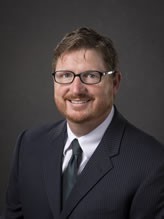
Dr. Martin Bell
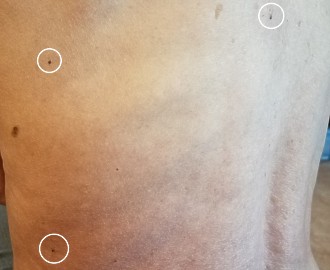
Tattoo Day - Gloria has always hated tattoos, but now she has four of them. But they were not part of a statement of "I am woman; hear me roar." They are strictly a functional part of her upcoming radiation treatments.
The diagnosis of cancer is certainly one that makes anyone sit up and take notice ... and, to be frank, is disconcerting. The fear
mobilized can quite naturally make a person think of cancer cells as being strong and powerful, while in truth, because they have
a damaged gene system, many are actually typically weak. It's a bit like the creature from outer space in the late-night horror
show that terrorizes the planet until some kid with a cold sneezes on the invader, causing the poor susceptible foreigner to keel
over and die.
We have never found a good way to take advantage of the weakness of cancer cells for a variety of reasons. One of those is that
they vary so much in the type of damage, that the weakness of one is not likely to be the weakness of another - no common
Kryptonite.
Three of Gloria's four tattoos. The fourth is on
her right side and cannot be seen
here.
One of our broad-brush and pretty successful ways of defeating cancer is to do something that stresses the body. The weak cancer
cells die in disproportionate numbers compared to healthy cells. The common methods of applying stress consist of chemotherapy and
radiation therapy. The former involves injecting a poison. It is generally the better tool when the cancer cells are disbursed
throughout the body. The circulatory system is generally used to transport the chemicals. Radiation is also a killer and is best
suited to cancers that are localized.
This is why on Tuesday Dr. Bell - the radiation guy - suggested radiation and Dr. Koeneke - the oncologist - suggested no chemo.
A hormone-related treatment will be considered down the road. Its aim would be to suppress a recurrence. But for now, it is
preparation for radiation that's to be used!
The "plan" is to microwave Gloria's left breast ... well, not exactly, but closer than one might think!
Her treatment will be 16 whole-breast doses of radiation to her left breast, followed by 4 doses concentrating on just the area where
the tumor had been found. These will be given one work day after another.
At the time of excision, Dr. Doering inserted three or four metal markers - typically about 1/10 inch long and made of titanium like
replacement joints - around where the tumor was removed to serve as "guideposts" for later treatments.
The radiation absorbed is measured in Gray units and she will get 50 total. If you are like me, that doesn’t mean much. Converting
that to something more familiar, that is the amount of energy every square inch of your exposed body receives from the sun in 30
seconds on a clear day.
Gee, that doesn't sound like much.
But all radiation energy doesn't have the same effect. Sunlight is much lower frequency radiation than the X-rays she will receive.
Sunlight does not penetrate the way X-rays do. So it takes much more sunlight to cause the equivalent amount of cell damage and that
damage is much more superficial. A person bathed in X-rays with the same energy level as sunlight would only require about 8 minutes
to be fatal!
So why did I the mention microwaves? The energy source in these treatments is generally a magnetron tube - the same item that
makes the microwaves in your kitchen counter-top unit of the same name. Then what is called a linear accelerator boosts the energy
considerably.
But Gloria will not be getting in a little box shuttered by a door with a grill on it. When radiation was first used as a therapy,
the energy flooded out of the machine in a rather broad fashion. Patients wore lead-filled garments to absorb energy heading toward
undesired destinations. Think of the old days of dentist-office X-rays!
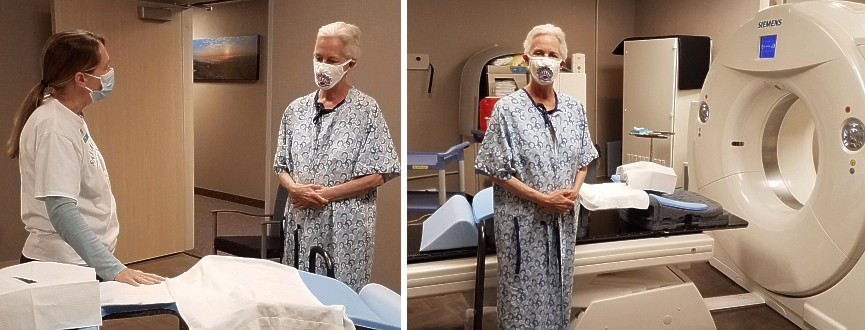
Left: technician Leann shows Gloria the fixture she will lie face-down on to allow her left breast to "drop" through the gap seen below Leann's hand. Right: Gloria just before her CAT scan that generates a "roadmap" of her body.
But over time, they found ways to focus that energy. The lead-lined clothing gave way to making certain the now-narrow beam was
always properly focused. This meant a way was needed to accurately align the beam with the patient. The default approach was to
place several small tattoos on the patient’s body - reference points that won't come off in the shower or move from sweat created by
cutting the grass on a warm-summer day in Kansas. Lasers are then used to evaluate the patients positioning compared to those
tattoos.
As an aside, some people have religious objections to any tattoo. Still others find the small dots that are about 1/10 of an inch in
diameter a disturbing reminder of having had cancer. Yet others already have tattoos in the area, making any new ones hard to locate.
Alternatives are available. A clear cover over a temporary mark can work, but there is a danger that the cover will come off mid
treatment. The newest kid on the block involves scanning the patient’s related body area and then comparing that image with the
patient’s position on subsequent treatments.
Until just a few years ago, tattoos were placed on a woman's chest area and she was on her back during treatment. But someone realized
that if the woman was on her front and the area below the breast was open, the breast would naturally fall away from the chest wall,
making it easier to concentrate the beam on the breast and avoid the rib cage and the heart and lungs it contained. So that is what
Gloria will experience and why the tattoos are on her back!