Kansas Snapshots by Gloria Freeland - March 20, 2026
"The Institute Cook Book" - Part 2
The cookbook I wrote about last week was among my parents' things when they passed. After flipping
through the pages, I began to wonder whom it had belonged to. There were no notations on the inside covers or in the page margins to
serve as clues. But it was bulging with handwritten and typed recipes, yellowed and frayed clippings from 1920s and 1930s newspapers
and magazines, and 1940s brochures. Some were stuffed inside the front and back covers, while others had been slipped between pages.
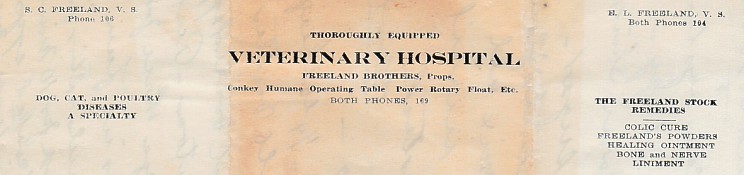
As I went through the items one by one, I came across letterhead stationery from the Marion, Kansas veterinary hospital owned by my
great-great uncles Sam and Ed Freeland. On the front side were handwritten recipes - one for hand lotion and the other for
green-and-red-pepper relish. "An odd combination," I thought.
Letterhead from Sam and Ed Freeland's veterinary business in Marion
But on the back was a note addressed to my grandmother Ethel and signed "Aunt Madge" - Sam's second wife. That probably meant the
book belonged to my grandma! My Freeland grandparents were married in 1913, so the cookbook might have been a wedding gift. It did
contain a clipping from the Colorado Springs Gazette of August 15, 1930, a time when they lived nearby.
With my curiosity now piqued - or maybe Art's obsessive-compulsive nature rubbing off on me - I carefully went through everything
again.
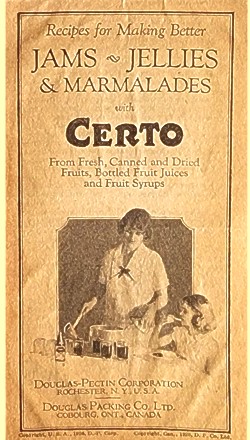
One item, a small 1926 pamphlet, was titled "Recipes for Making Better Jams, Jellies and Marmalades with Certo."
Certo?
I quickly established I'm not much of a cook because I had never heard of it. But a Google search revealed it is just pectin,
a thickening agent widely available yet today.
Quite different were two "Food for Freedom" pamphlets from 1942, published by the Bureau of Home Economics in the U.S.
Department of Agriculture. One was geared to children ages 9-12:
... What action can you take in Uncle Sam’s home-defense army of boys and girls doing a 100-percent job of eating? ... If you live in the country, you can help feed the cows ... or help raise calves, baby pigs and little chicks. You can plant vegetables and work in the garden. If you live in town, you can help your mother choose the foods you need when she buys. ...
The other had advice for workers carrying their own lunches to their defense jobs.
... Now that war production speeds night and day, thousands of workers eat at topsy-turvy hours. Whatever the hours of the working shift, don't eat hit-or-miss meals. ...
A brochure for Certo pectin
Yet others included household tips. One newspaper item from an Oregon reader explained:
Vinegar may not catch flies, but it is a handy help around the house ... Vinegar will clean windows ... vinegar and kerosene, equal parts, is all I ever use on my woodwork ... vinegar and salt will polish the brass and copper ... I forgot to mention there is nothing better than hot vinegar packs for sprains and bad bruises.
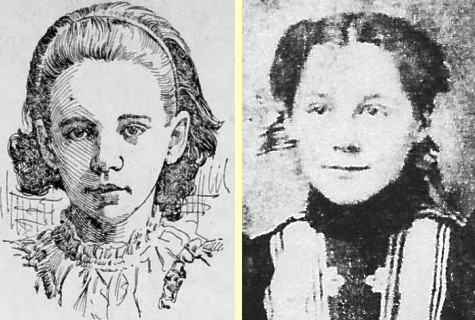
Having maxed out on recipes and home-care tips, I wondered what I could learn about Helen Cramp, the cookbook's editor. Born in 1886, she was my grandma’s contemporary, being a little less than a year younger. A fun newspaper article with a pencil sketch of Cramp at age 10 was about her enlisting three other girls to put on a small play to raise money to send four other youngsters to a summer camp. It also mentioned Cramp was an outstanding student.
As an adult, she became a copywriter and then editor in Philadelphia and then moved to New York City. She was the editor of
Parents' Magazine for a time, wrote poetry, and authored other books, including "The Winston Cook Book" and "Letter-Writing,
Business and Social." In 1922, she married artist Preston McCrossen in New York City and they had three children. She died in
Santa Fe, New Mexico in 1951.
While grandma never lived in a big city or worked outside her home, she also had three children. Both women would have lived
through the Great Depression of the 1930s and U.S. involvement in World War II in the 1940s - times when all families,
regardless of circumstance, were advised to be frugal.
Helen Cramp (left) and Ethel Stewart at approximately age 10
Grandma was only 5 when her own mother died from tuberculosis. Lacking the training mothers typically gave their girls, after she
married, grandma probably needed all the help Cramp's book could provide.
The cookbook and its "scraps" kept me entertained for some time. But why? After all, they were not particularly unique.
Perhaps the answer was in a column I wrote 10 years ago called “Missing pictures.” Most of us
have at least a passing curiosity about the generations that came before us. Yet of the daily events that filled the hours of
their days, many of us know little. Men typically worked outside the home, often away from home. A woman's day was usually
housework and raising children. We generally didn't write about those things or photograph them. We instead documented "special"
events, such as holidays, marriages, birthdays and vacations. The hours and days that made up the majority of their lifetimes
are captured in relatively few pictures.
That cookbook and all its accompanying items were every bit as much a part of grandma's life as the quilts she made that I
treasure as keepsakes. While the recipes and advice in "The Institute Cook Book" were an interesting glimpse of life at those
times, the extra items tucked inside its pages gave me a better appreciation of my grandmother's circumstances and how she handled
her important role as wife and mother.
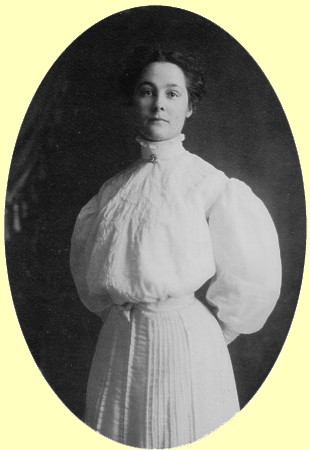
Ethel May Stewart shortly before her
marriage to Robert Haddon Freeland
Comments? [email protected].
Other columns from this year: Current year Index.
Links to previous years are on the home page: Home