Kansas Snapshots by Gloria Freeland - March 13, 2026
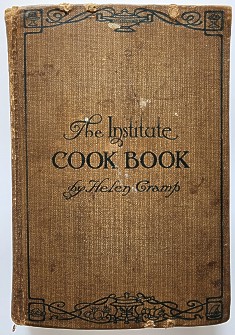
"The Institute Cook Book"
While searching for husband Art's Vaughan-family Bible, we encountered an old book from my family - "The Institute Cook Book" by
Helen Cramp. Its cover is well-worn, the binding is coming loose, and many of its pages are stained and dog-eared - the result, I
assume, of being well-used.
No publication date was listed, but that was almost certainly intentional, allowing the publisher to sell copies over a span of
years without it appearing dated. The first edition was printed in 1913 by the Domestic Science Department of the International
Institute. It was intended to help two groups. One included foreign-born women seeking work as domestic servants, who were
ill-prepared in the early 1900s to handle the expectations of their upper-class employers. The other group was the young women
from those same families, who often pursued higher education, and so approached marriage with few culinary skills.
Among the first pages of the book was an enrollment certificate. Annual dues were $1.75 - equivalent to $33 today. In return, members
received the cookbook and "expert advice ... upon cookery, home decorations, domestic economy, household management, etc., etc."
Members could write to ask questions about any of the listed topics.
My newly-discovered old cookbook
Books.Google.com said the cookbook "has been selected by scholars as being culturally important, ..."
As a history nut, I can definitely see its value in showing how recipes, methods of food preparation, and attitudes about cooking
have evolved over the years.
In the introductory chapter, "The Fine Art of Cookery," Cramp stated:
... If we are "but what we eat," we are also in a very real sense the product of all the influences that play about us as we eat.
The child, contented over his morning bowl of oatmeal, is not unmindful of the cleanliness and order of the table at which he sits
... Nor is it only the child who is influenced. A poor meal, served in slovenly fashion, will upset many a healthy man's temper for
the day. After all, one's philosophy is largely a matter of what one has had for breakfast. ...
Maybe I need this book. We're not really breakfast people. A cup of coffee and some yogurt or a piece of toast are our most common
breakfast staples.
Subsequent chapters included recipes for appetizers, soups, eggs, meats, salads, vegetables, desserts, and other categories typical
of any cookbook.
I looked at the chapter on cakes to see what sounded appealing and maybe just a little different. Snippy-Doodle Cake caught my eye:
Beat the butter and sugar to a cream and add the egg. Then stir in the flour and the milk alternately; add the baking powder last.
Pour into a shallow, greased baking tin; and sprinkle with sugar and cinnamon. Bake in a moderate oven.
What size baking tin? What's a moderate oven? How long should it be baked?
Many recipes had this same “by-guess-and-by-golly” feel to them.
One thing I had never seen in a cookbook was advice devoted to cooking for sick people, but this one had an "Invalid Cookery" chapter. The introduction seemed hopeful:
Cooking for an invalid is by no means a difficult task; but care is necessary in order that the product may be as appetizing and
as digestible as possible. The serving, too, is important: only the daintiest china and glass should be used in the sick room; for
the patient is seldom hungry and needs to be “tempted” in every possible way.
Several recipes caught my eye - Oatmeal Gruel, Egg Gruel and Cracker Gruel - among them. Perhaps the word "gruel" held more appeal
in 1913.
There was also a recipe for Calf's Foot Jelly:
4 calves' feet
3 quarts water
1/2 pound powdered sugar
Whites of two eggs
Clean the feet thoroughly and boil them slowly until the three quarts of water are reduced to one. Strain and set away until cold;
remove the grease and place the jelly in a saucepan, being careful to avoid the settlings. Add the sugar, lemon juice and whites of
eggs; let all boil together for a few minutes; pour into bowls or glasses and set away to cool. This is much more nourishing than
the commercial gelatine.
Well, that recipe certainly left me with little hunger!
To be fair, gelatins used to be made from the hooves of cattle and horses. And while we cringe at the thought of it today, that
springiness in Jell-O and marshmallows still comes from the collagen harvested from cattle, chicken, pig, and fish parts.
As I perused the recipes, I noticed that some sounded pretty familiar - clam chowder, pot roast, salmon, chicken pie, and scrambled
eggs. But others were unusual, or at least unusual for those of us cooking today - ox-tail soup, baked calf's head - with admonitions
to have the butcher remove the eyes and cut off the nose first, frogs - under the "fish" chapter, partridge pie, and "kedgaree" -
a codfish omelet.
The recipes and advice throughout the book were interesting, but I kept wondering who it belonged to. There were no inscriptions or
notes written on the inside covers or on the page margins to indicate ownership.
My grandparents Robert and Ethel inherited many items from grandpa's uncles Sam and Ed, who were veterinarians in Marion, Kansas.
After Sam's and Ed's deaths, their belongings were stored in old trunks in outbuildings at grandpa and grandma's farm. After my
grandparents' passing, mom and dad moved to the farm. When I asked what the trunks contained, they always referred to the contents
as "the Marion stuff."
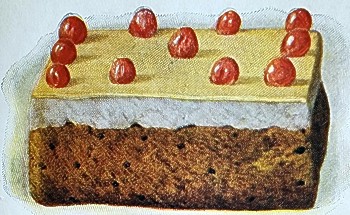
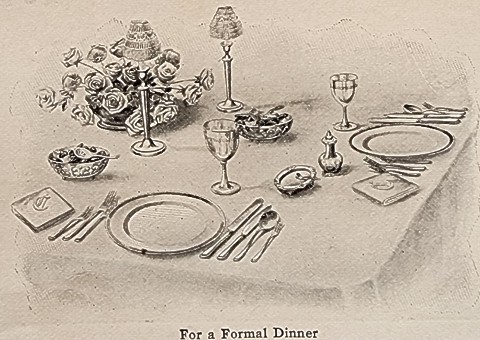
The book had a variety of helpful illustrations.
A suggested formal dinner table arrangement
And now, lucky me, it's mine, including "The Institute Cook Book."
So who owned it? Was there a clue in the recipes clipped from newspapers and magazines, the canning tips, and the World War II-era
brochures stuffed at the front of the book and between some of its pages?
Sounds like next week's column to me.