
TAKE TWO - 3 November 2025

The Human Condition - A few years after Gloria’s dad died, her mom started “spending time” with a retired professor. Stan's
area was biology-related, meaning he understood better than most the workings of the human body. One day after returning from the
doctor, Stan declared in a calm manner that he had received his death sentence ... he now knew what was going to kill him.
He explained he had been diagnosed with an incurable blood cancer and the best that could be done was to "kick it down the road"
some.
Stan did die ... but it was a number of years later and not of his cancer. He died of heart failure.
Stan was a smart guy and certainly knew that at his age, if the cancer could be put off some, he’d likely die of something else. But
the emotions associated with cancer make it easy for any person - even one like Stan familiar with the science - to fixate on it
alone.
And it isn’t just the person dealing with the disease. It becomes easy for friends and relatives to think first and foremost of the
person’s illness. At the age of 64, my father was diagnosed with a blood cancer. He was told it was incurable and if all went well
with the treatments, he might have five more years. Instead, he lived for 15 more, beating the national average for males by 5 years.
During his latter years, his doctor told him he wasn’t even sure dad still had cancer. His death, in many regards, was very much like
that of his own father ... he just sort of faded away, but not in the way many cancer victims do. Still, to this day, a number of my
relatives invoke cancer as being a cause of his death.
In contrast, dad just saw its approach as a consequence of getting old!
Fortunately for both of us, Gloria is a farm gal who has repeatedly mentioned over our decades together her fondness for the notion,
"to everything, there is a season." Gloria and I spend minimal time thinking about what we once could do, but now cannot. Neither
of us will be 20 again, so acting as if we were would not just be foolish, but also frustrating, which, in turn, would kill the
joy of life.
Youth is the time of cures - when a broken bone mends and we soon forget about ever having one. But most of us, if we are fortunate
to live long enough, are like the characters in the Jack Nicholson-Helen Hunt movie "As Good As It Gets." It will never be perfect
and often not even as good as it was, but it is still good. I once heard a comedian say that one of the advantages of getting older
is eventually everything has a lifetime guarantee. The average life expectancy for a female of Gloria’s age is about 15 years. In
my case, I’ve already passed my "use by" date. So we just keep enjoying life, and do what we can, to keep kicking things down the
road. These treatments are part of that.
Meeting with Oncologist Travis Koeneke - Today, Monday, November 3, we had a 4 p.m. appointment with Dr. Travis
Koeneke, an oncologist, to get the chemotherapy process started. Mary, one of the nurses Gloria had at the hospital after the
mastectomy, didn’t hold back when she heard he was in our future. She, too, had breast cancer some years back and she exclaimed,
"I just love him!"
That’s a good sign.
If at this point Gloria quits being "different," and settles into being plain old boring "average," the statistical likelihood of
kicking this down the road to where it isn't relevant is in the better than 90% area.
Treatment Strategies - There really are only two cancer treatment strategies - cut it out or keep it from proliferating. The
latter category includes those we can kill. Gloria has now ridden the former approach about as far as she can.
The second strategy is directed by an oncologist whose challenge is to make life hard for cancer cells, while allowing the
non-cancerous ones to live long and prosper.
We commonly think of cancer cells as ones that reproduce too quickly, but the notion of "too quickly" is simplistic. Some body cells
normally live less than a day - white blood cells, intestinal cells - and so require frequent replacement, while some nerve cells
are thought to never reproduce. So reproduction rate alone is not sufficient to distinguish the good guys from the bad guys.
It is true that a cancer cell has a different genetic makeup than its noncancerous predecessor and neighbors. This suggests a
therapy where the cancer's DNA is sequenced and its unique features used to create a pathogen that seeks it out and destroys it.
This does work - sorta! At present, the process is laborious - meaning costly and time consuming - and its effectiveness is
limited by the fact that today's cancer cell can mutate tonight into tomorrow's version that has a different genetic makeup.
So, despite the fact that we’ve been wrestling with cancer for years, even today, our most effective tools are blunt instruments
that create a significant amount of collateral damage. Some of the chemicals Gloria will receive will be disproportionately taken
in by rapidly dividing cells, likely killing them. But intestinal cells, white blood cells, hair cells and other quickly-dividing
cells will be wounded and some killed in the fray.
Gloria spoke with her friend Judy recently who previously had breast cancer. All of her markers were negative, meaning her cancer did
not respond to any other treatments than the poisons. In addition, hers was quite aggressive. But despite the options being limited
and the prognosis poor, she not only lived five years, but is now at the seven-year mark with no cancer detected.
In contrast, all of Gloria’s markers were positive. The ER and PR markers indicate that the hormones estrogen and progesterone play
a role in fueling her cancer cell proliferation, so one option is to give her medications that attempts to block their functioning.
The HER2 protein also plays a role in cell multiplication. Gloria's cancer has an excess, so medication that interferes with its
operation is also an option.
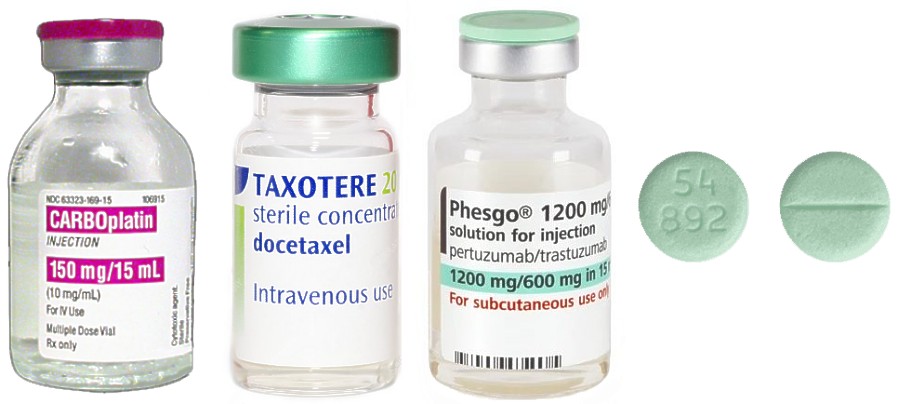
Day-Two treatment drugs
Koeneke's "Plan of Attack" - Our meeting was a 55 minute one, but when you remove the time the nurse used taking vitals and
checking past medical history, the total time focused on the future was probably more like 30 minutes. Probably 10 minutes of that
was Koeneke reviewing the pathology reports and comparing them with our understanding. His and our understanding of the situation
matched completely. The only "news" was that the final HER2 test - the FISH Test - on that "surprise" third cancer came back and
it was judged negative.
Koeneke's plan had two parts.
1. The first would involve six cycles of treatment where each cycle is three weeks in length. Each 3-week cycle would be as
follows:
Gloria will take the following compound as a pill:
- Dexamethasone - (deks-a-meth-a·sohn). Steroid taken as two pills in the morning and two pills in the evening that will
tamp down her body's natural response, such as nausea, to the drugs she will receive the next day.
Day - 1
Gloria will receive at least five compounds. Four of these are directed at the cancer. The first two are given via her
Port-a-Cath, the next two via a single injection, and the third by mouth. These five are:
- Carboplatin - If carbo is taken from Carboplatin (car-BO-plat-in), and “um” added on the end, you end up with the name of
the pricy metal in the compound. But the amount given Gloria will not make her rich, although it may help the doctor in this
regard.
Carboplatin binds with a cell's DNA strands, making life hard for the cell via three mechanisms. By attaching to the DNA, it acts
much like a cover. This prevents the cell from making the corresponding proteins that part of the DNA codes for. In addition,
at some locations the two strands may be bound together by the chemical, thwarting the separation required for DNA duplication
to make a new cell.
Finally, there are mechanisms within a cell that work to correct such problems. But with carboplatin present, this action
instead tends to split the DNA into useless fragments.
These actions not only doom the cell’s efforts to replicate, but frequently trigger cell suicide.
- Taxotere - Taxotere (taks-o-teer) operates in two ways. Cells have all sorts of interesting elements in them. One of
these is microtubules. They are chemical polymers which play a role in moving things about within the cell as they have the
capability of growing and shrinking. To replicate, a cell must duplicate its chromosomes and then have the originals and the copies pulled
into the respective parts of the cell before it splits in half. Taxotere encourages microtubule growth, but blocks shrinking.
This stops the cells from completing replication. This midway stop may trigger suicide. Taxotere encourages suicide by
interfering with the compounds that normally keep the chemicals apart that begin the self-destruction process.
- Phesgo - Phesgo (fes-goh) is actually two drugs in one. Trastuzumab (tras-too-zoo-mab) and pertuzumab (per-too-zoo-mab)
are laboratory-engineered substances that bind to HER2 receptors on a cell, thus blocking their response from hormones that
would be interpreted as a call for the cell to replicate. In addition, it attracts attention from the body’s immune system,
encouraging it to see the tagged cell as a foreigner to be destroyed.
- Dexamethasone - (deks-a-meth-a·sohn). Steroid taken as two pills in the morning and two pills in the evening
that will tamp down her body's natural response, such as nausea, to the other drugs she will receive today.
Day - 2
Gloria will receive two drugs. These are directed at some of the negative effects the Day - 2 compounds have on her body. The
first will be an injection and the latter is a pill taken by mouth. These are:
- Neulasta - (nyoo-LAS-tuh) or something similar. Because white blood cells are fast reproducers, the Taxotere and
Carboplatin can knock them down badly, making the recipient more susceptible to infections. This compound mimics a chemical that
naturally-occurs in the body that triggers the development of more white cells.
- Dexamethasone - (deks-a-meth-a·sohn). Steroid taken as two pills in the morning and two pills in the evening that will
tamp down her body's natural response, such as nausea, to the drugs she received the previous day.
Day - 3
Gloria will take nothing while the previous medications do their work and the body recovers from their ill effects.
Day - 4 to 21
2. Part two of the plan begins after the six cycles are complete. She will then drop back to every 3-to-4 week Phesgo treatments
for the remainder of the year.
Side Effects - There will be regular laboratory tests to monitor vital health elements to make certain all are within a
healthy range. Other medications may be prescribed to deal with these side effects.
Anyone who has ever listened to a TV commercial for a new drug is aware that the possible side effects to most
are numerous. For acetylsalicylic acid, the site drugs.com listed 46 side effects. Below those, was a section titled "Other Side
Effects" that listed 11 more. In case acetylsalicylic acid is unfamiliar, it is the chemical name for aspirin. So I will address
only those that are likely to occur and others only if they do occur down the road.
Common side effects include:
- loss of hair as the drugs also work against those rapidly dividing hair cells
- nausea as cells in the intestine are susceptible for the same reason
- tiredness due to the body using its energy to fight back
Final Thoughts - Koeneke did not want to begin until Gloria was at least four weeks out from her surgery, or sometime AFTER
November 11. This was to give her chest time to heal.
She will also be given a CT scan as a baseline, looking for any cancers elsewhere. In addition, there will be bloodwork that is not
entirely routine. There will be an update describing what that is about later. In addition, she'll have a heart echocardiogram. Rarely,
these drugs do some heart muscle damage. This before-treatment echogram will give a baseline to compare with.