TAKE TWO - 15 September 2025

A Lumpectomy - As with the left breast in 2022, Gloria opted for a lumpectomy. On Monday, September 15, a small radioactive
"seed" was placed at the site of the new cancer in the right breast. Since this cancer did not form a hard mass and was so small, the
surgeon needed something to guide him to the site. The seed - about the size of a rice grain - was positioned based on the
radiological images. During surgery, using an instrument that is in reality a tiny Geiger counter, the doctor locates the cancer site
and removes an area around it in the hope of removing all of the cancerous cells.
Early the following morning, Gloria had a radioactive dye injected near the nipple on the right breast. Why?
While almost everyone knows about veins and arteries, our lymph circulatory system doesn’t get near the same attention and so it is
less known. The reason we have a blood circulatory system is to bring nutrients and oxygen to each of the body’s cells and to take
away carbon dioxide and other waste the cells generate. This process necessitates the former elements pass through the walls of the
blood circulatory system to get to the cell. The latter must then pass in the opposite direction to be taken away.
But our primary circulatory system is better at doing the former than the latter, and that turns out to be a good thing.
While the lymph system could be thought of as a sort of "drip pan" that collects the remainder, this characterization creates the
impression that its sole function is to fix the shortcoming of our principal circulatory system. That is not the case.
The lymph system contains filter nodes along its route that accumulate and deal with such things as dead cells and disease
components. One concern with cancers is the possibility of a cancerous cell breaking free from the initial site and traveling to
some distant part of the body and establishing a new colony there. If cancer cells are not found in a node that filters the area of
the cancer, then there is a great likelihood that it hasn’t spread.
But to test for cancer in a node, the surgeon first has to know where the node is so he can remove it for testing. The injection of
a colored and radioactive dye near the site of the cancer addresses this location problem. The dye will flow along the breast's lymph
system toward the nodes located in the nearby armpit. But unlike much of a human's anatomy, the precise location of the related nodes
is somewhat different in each person.
With Gloria's scheduled surgery being near midday, enough time had passed by then for the slow-moving lymph system to have carried
the dye to the appropriate nodes. After hopefully removing all the cancer at the original site, a small radiation-detecting wand was
moved into the armpit area looking for a “hot spot” created by the accumulated radioactive dye.
The surgeon then opened the area and looked for the telltale coloration from the dye. Those nodes were then removed for testing.
A new "wrinkle" added since 2022 was having a nurse call me during the procedure to inform me of the current status of events.
Post-Op - The operation only lasted about an hour. Gloria was then stitched up and sent to the recovery area. With "Doc"
Doering stopping by to give me an end-of-action report when he was done, the telephone call seemed like overkill. But, of course,
this is the judgment of someone who grew up when immediacy did not have the priority it enjoys today.
We left the hospital somewhere around 4 p.m., but the pharmacy hadn't had time to finish Gloria’s pain-medication prescription.
So we decided to dine on some haute cuisine - meaning a cheeseburger for Gloria and a Big Mac and fries for me.
Those who know us are at this point probably asking, "What? Not Culver's?" No, as it was on the opposite side of town, and Mickey
D's was right there. Now we wait the next pathology report.
We then headed to nearby Cico Park and "dined" in leisure.
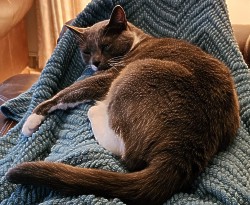
Gloria's cat Minnie comforting her master after surgery