
TAKE TWO - 14 June 2026 - SOZO

The SOZO and What It’s For
The SOZO Device - The SOZO unit is an electrical device first approved in 2017 by the U.S. Food and Drug Administration for use
as a diagnostic tool in the treatment of conditions associated with body fluid imbalances such as those that occur with lymphedema,
heart failure and kidney failure. It is manufactured by the Impedimed company of New South Wales, Australia. According to their website,
"the Greek word 'sozo' has been translated as: healed, preserve, save or saved, well, and whole."
Gloria was introduced to the device by clinician Stephanie Johnson as a consequence of a referral by Gloria's radiation oncologist Dr.
Martin Bell. He was concerned she might develop lymphedema as a side effect of her surgery and/or subsequent radiation during treatment
for her recent breast cancer. Consequently, the discussion here will focus on the SOZO's use relative to lymphedema.
What is Lymphedema? - Lymphedema is a condition where fluid from the human body's lymph circulatory system fails to find its way
back into the blood circulatory vessels and instead pools in other locations. In Gloria's case, the upper right arm is most at risk.
Early detection of the onset of the disease makes treatment outcomes better and the SOZO device has been shown to be superior in this
regard compared to previous methods.
Lymph System Review - The blood circulatory system brings nutrients and oxygen to each of the body's cells and takes away carbon
dioxide and other waste the cells generate. This necessitates the former elements pass through the walls of the blood circulatory
system to get to the cell and the latter move in the opposite direction to be taken away.
But our primary circulatory system is better at doing the former than the latter, and that turns out to be a good thing.
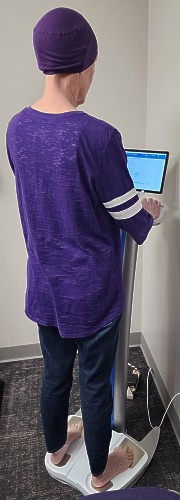
Gloria on the SOZO machine
While the lymph system could be thought of as a sort of "drip pan" that collects this excess, it also creates the impression that its sole
function is to fix this shortcoming of our principal circulatory system. That is not the case.
The lymph circulatory system contains filter nodes along its route that accumulate and deal with such things as dead cells and disease
components. One concern with a cancer is the possibility of a cell breaking free from the initial site and traveling to some distant part
of the body and establishing a new colony. If cancer cells are not found in a node that filters the area of the cancer, then there is a
great likelihood that the cancer has not spread.
In the case of breast cancer, a radioactive dye is injected near the site of the cancer. After some time passes to allow the lymph to
flow, a probe sensitive to radioactivity is used to locate a node or nodes that have accumulated the dye. A surgeon then opens the area,
looking for a node with the telltale dye.
To test for cancer, the surgeon will remove the node(s) for analysis. This necessarily causes a disruption in the lymphatic system. But
because there are many nodes, the removal or damage to one or two is unlikely to create a problem. In the case of breast cancer, these
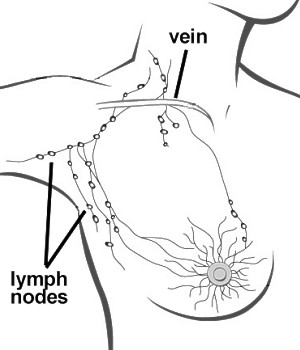
filtering nodes are typically located near the affected side's armpit and the collected and filtered lymph is returned to the blood
stream in the subclavian vein near the collar bone.
If cancer is found in the test node(s), as in much of medicine, options come with a companion downside. One school of thought is many
of the surrounding nodes should also be removed as they may well have cancer cells in them too. Another approach is to instead use
radiation in the affected area to kill any cancer cells that remain behind. A third option is to do both.
Right breast and part of the nearby lymph system
None of these is a get-out-of-jail-free card. All disrupt the lymph nodes and ducts and may lead to lymphedema. While it is not the threat
to life that cancer is, it can materially negatively impact the quality of life for the sufferer, and, in the worst cases, the pooling
area can become a site for infections.
While some of these cases can be addressed with surgery, often the only realistic treatments are compression garments and massage therapies
that might have to be continued throughout the remainder of the sufferer's life.
Traditional Lymphedema Diagnosis Approach - One traditional method of diagnosing lymphedema arising from breast cancer treatments
is by measuring the circumference of the arms on both sides of the body and comparing. A difference of 2 cm or greater in the upper arm is
often considered the threshold for a positive result for the side of the larger limb. But there are problems with this approach - a person
may not initially be symmetric, both sides may have been treated, measurements are hard to make in a consistent fashion, etc. So making a
proper diagnosis can be difficult and very subjective.
SOZO Diagnosis Technique - What would be helpful is a reliably repeatable way to measure the amount of water in the body's limbs.
The SOZO measurement technique involves passing low-level electrical currents through body parts and measuring the opposition to that
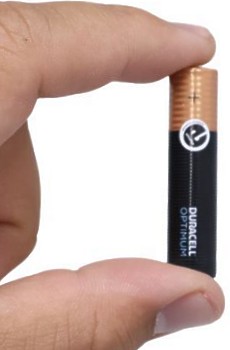
flow. This will indirectly measure the water content. The voltages required to generate these currents are very small. The amount
created in a person's hand when holding a flashlight cell between the thumb and forefinger may be greater than the current produced
by the SOZO device.
The SOZO's currents are in the neighborhood of 0.0002 Amps (200 uA). This level is so small, it is not just safe, but virtually
undetectable. This means the patient is completely unaware of the measurement process, which once initiated, takes less than 30
seconds to complete. When Gloria was scanned, she said the experience was like nothing more than standing on a doctor's-office weight
scale.
Unlike the flashlight cell which generates a current that flows in only one direction (direct current or DC), the SOZO uses
alternating current (AC) which flows first in one direction and then reverses. These reversals occur as slowly as 3,000 times per second
(3,000 Hz or 3 kHz) to as high as 1,000,000 times per second (1 MHz).
The SOZO-generated current is typically smaller than created by this cell
The voltage application points and the response-measurement contacts are through metal-against-skin locations, so except for the actual
current, everything is external.
The SOZO unit interfaces with the clinician through a wirelessly-connected (Bluetooth) tablet running Impedimed's proprietary
software. The software includes components that do other things as well, but the unit's "claim to fame" is its fluid measurement
capability.
Online Manual - The device's manual is available online, but is oriented toward the assembler and/or user of the completed unit.
Since the SOZO is a proprietary device and no doubt contains hours of invested research, the company has little interest in revealing all
of the details. So some of what follows is supposition. But in the process of having the device approved by the FDA and having it accepted
by the medical community, the general details of its operation are reasonably well known. The discussion that follows focuses on how the
device operates.
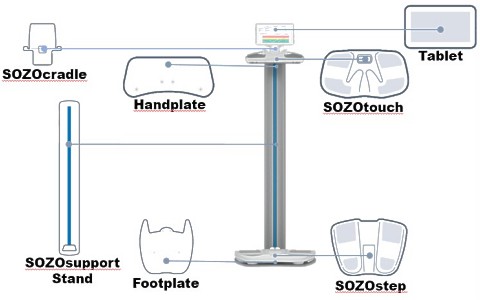
Appearance - The unit's appearance is similar to that of an ordinary medical-office weight scale, except there is a tray at
approximately elbow level.
The patient stands on the device with bare feet. The footplate has four metal areas, one for the toes of each foot and a separate
one for the heel of each foot.
The patient's hands are placed upon the waist-high tray. It too has four metal areas, two for each hand, one for the fingers and one for
the palm.
The unit can be adapted to accept a person in a seated position.
Components of the SOZO device
Electrical Conductivity - To understand how the device works, a rudimentary understanding of electric current flow is required. Danish physicist Niels Bohr's "solar system model" of the atom is quite adequate to explain the process.
The atom's equivalent of the sun is the nucleus consisting of large positively-charged protons and slightly-larger neutral neutrons.
Swirling about the nucleus like the planets circle the sun are negatively-charged tiny electrons. Opposite signed charges are attracted
to each other, while similarly charged ones repel. Neutral ones play no role in electrical considerations.
Atoms don't fly apart because the nucleus contains what has at times been characterized as a strong "nuclear glue." Without it, the
protons would separate.
By appropriately spacing two atoms, the outer electrons from one may easily move to its neighbor and vice versa. Metals such as gold,
silver, aluminum, and copper form solids at normal temperatures with just such a distance and so electrons can easily "skip" from one
atom to another, and then another, and so on.
Bohr model of an atom is similar to the solar system's structure
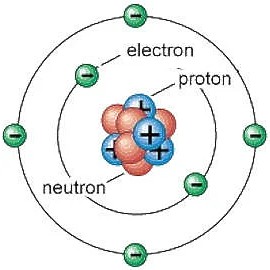
Any source of energy can be used to forcibly separate an atom's electrons from its protons to make an excess of one in one location and of
the other in another. Solar cells use light; electrical cells - commonly called batteries - use chemicals; thermocouples use heat; power
plants use a variety of sources; and so on. Regardless of how the separation is created, when a metal is connected between the separated
charges, electrons will flow through it from the area of excess to the area of shortage, creating a current. This will continue as long as
the path remains and energy is supplied to keep separating electrons from their atoms.
While metals are good conductors of electricity, pure water is a terrible one. But if a small amount of certain items are added to the
water, even though neither by themselves is a good conductor, together they can carry a current. Sodium chloride - ordinary table salt -
is such a material. The water of human blood has enough salt in it that the mixture is 10,000,000 times MORE conductive than pure water.
This is due to water separating sodium chloride into separate atoms of sodium - which is short an electron because it gave it to the
chlorine atom and so positive - and atoms of chlorine - which have the sodium atom's extra electrons and so are negatively charged. Atoms
which have gained or lost electrons are said to be ionized.
If a source of electricity, such as a cell, is connected to blood, the negatively-charged chlorine atoms near the source's positive terminal
will give up their electrons to it because to be positive it must have a shortage. At the source's negative terminal, there is a surplus of
electrons that will be injected into nearby positively-charged sodium atoms. Then those sodium atoms hand electrons over to neighboring
chlorine atoms that in turn hand them on to neighboring sodium atoms and so on, thus closing the loop and creating a current.
Metal atoms, such as iron, are so rare and widely dispersed in the human body that any current flow of that type is impossible. The flow
that arises by holding the cell between the finger and thumb is instead due to ionized salts in the body.
Whether the charge flow is due to the movement of electrons, protons, ions or some combination, it is measured in Amperes. The pressure
that prompts them to move is measured in Volts. The ratio of the pressure in Volts to the resulting flow in Amperes is called the
resistance and measured in Ohms.
Pressure (in Volts) / Current (in Amperes) = Resistance (in Ohms)
Whether it is an electrical wire or a human limb, three factors will determine its resistance:
1. Length - The longer the current path, the lower the flow and so the higher the resistance.
2. Area - Just as a larger water pipe carries a greater water flow for the same pressure, a conductor with a greater cross section will
carry a greater current flow for the same voltage and so the resistance is lower.
3. Resistivity - This is an inherent conductive characteristic of the material - adding more salt to blood or using a wire made of copper
rather than aluminum will increase the current as the conductivity is greater.
So if a voltage is applied between the elbow and the wrist, a longer arm will have more resistance. But an arm with more flesh and so of
greater cross-sectional area will have less, as will one with saltier fluids. So the resistance of the forearm will vary from person to
person.
The four-point measurement scheme - When very accurate electrical measurements are desired, a four-connection-point system is often
used. Whether it be electrical flow in a conductor, water flow in a pipe, or wind flow in an air duct, there is often turbulence - uneven
flow - at the point the current enters and leaves the conduit i.e. a wire, a drain pipe, or an air duct. The same is true when the conductor
is the human body as it is with the SOZO device. To obtain accurate flows, it is common to measure them well away from these entry and exit
points. In the SOZO, this scheme could be implemented by having the current enter via the fingers and leave via the toes while measuring
the voltage between the palms of the hands and heels of the feet. (Note: since the device's current is of the alternating variety -
constantly reversing direction - it could enter the fingers and leave the toes at one moment, while being the reverse the next.)
Constancy of Blood - The chemistry of the blood and lymph for a healthy person only varies over a relatively small range. This means
that the characteristic resistivity of these fluids is very similar person to person. Since most humans are very similarly shaped, then the
resistance between the corresponding points on various bodies should be related to the amount of water they contains. A thin person will
have both less area for the current to flow through and a corresponding smaller amount of fluid, leading to a higher resistance reading. In
this way, resistance becomes an indirect measure of fluid content.
Complications - However, a closer look reveals the situation is more complex. The body also contains bone, which is a good
insulator. Another factor is the walls of cells are reasonably good insulators and do not allow steady currents to readily flow through
them. Red blood cells are a major blood component - about 43 percent. While the interior of a red blood cell is a reasonable conductor,
its walls are good insulators. So while the resistance measurement will be related to the liquid in the body, it will largely be due to
the liquid that is outside the cells.
Complication a Good Thing - While we generally look at a complication as something to be overcome and not being a good thing,
sometimes gray clouds do hide a silver lining. Applying a small voltage to the human body will produce a current in the liquid outside
the cells. The resistance measured will also be related to the water outside the cells - lower resistance meaning more water.
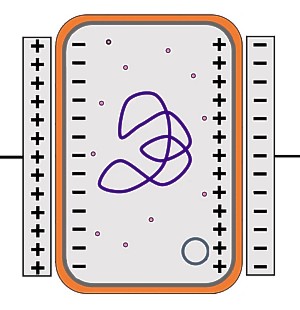
But what happens with a body cell with a voltage applied? As a simple approximation, the cell could be considered to be a liquid-filled
container separated from the outside world by insulating cell walls. The voltage will cause ions inside the cell to supply
electrons to move toward the positively-charged area and away from the negatively-charged area outside the cell. Due to the insulating
effect, they cannot move across the boundary, but they will attract additional charges near the boundary on the outside of the cell.
This "current" is transient, ceasing when equilibrium is established.
The colored area is an approximation of a
body cell reacting to two charged plates.
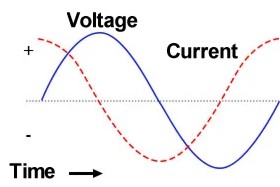
If instead of applying a steady voltage, we apply an alternating one, equilibrium will have to be established again and again. This will
add a small amount of current to that in the liquid outside the cell, but one of an unusual nature. This new current will be greater
the more rapidly the voltage is changing. If the voltage is of a sinusoidal shape as shown in the illustration, this current will
"lead" that voltage by 90 degrees - a quarter of a cycle.
The current (red) will be greatest when the
voltage (blue) is changing the most rapidly
and zero when the voltage is not changing
As with the current flow through outside-the-cell fluids previously discussed, increasing the voltage magnitude will make this "displacement
current" larger as well. But unlike the resistive current, this one can also be made greater by raising the frequency because the same
amount of charge must flow, but in less time.
Reactance - Since the AC voltage across an insulating barrier is shifted by a quarter of a cycle from its current, the instantaneous
voltage-to-current ratio ranges from zero - no voltage, but peak current - to unlimited - peak voltage, but no current. With this changing
instant to instant and ranging from zero to unlimited, this quantity has no practical value. However, the ratio of the magnitudes is
somewhat like resistance. To distinguish it from resistance, it has been named reactance and also expressed in Ohms.
Peak Pressure (in Volts) / Peak Current (in Amperes) = Reactance (in Ohms)
Total Current - The total current will be the sum of the two parts - the resistive current from flow through the outside-cell liquid
and a reactive displacement current charging and discharging the cell barriers. The total is larger than the resistive component alone, but
somewhat out of time with the applied voltage.
If the inside of the cell was metal, the displacement current would rise directly as the frequency rose. But this is not the case. The
liquid inside the cell also has resistance. With a DC voltage - zero frequency - or low-frequency AC, this resistance has little effect
as there is plenty of time to charge and discharge the cell boundary.
As the frequency rises, the charge/discharge time shortens, requiring a larger current. But the cell's internal resistance will limit the
current, so the areas opposite each other across the cell boundary will no longer have a current sufficient to fully charge and discharge.
If the frequency continues to rise, soon no significant charging and discharging will occur in the short interval between cycles. The
voltage is then effectively only across the cell's internal liquid. So while there are no charges passing through the cell walls, there
appears to be. The current at high frequencies will be determined by only the cell's internal resistance. Since there is no significant
charging and discharging of the wall boundary, the current will now be in step with the applied voltage rather than being out of step.
Inside and Outside - When the applied voltage is of a single polarity and magnitude (DC) or of a low-frequency reversing (AC), the
current is all or largely due to the conduction in the fluid outside the body's cells. At very high frequencies, there is the
additional current path through the cells and so the total current is higher. The difference between the two is the current through the
cells. The SOZO's lower measurement frequencies will produce a resistance value corresponding to the extra-cellular fluid present. The
high frequency values will correspond to both extra-cellular and intra-cellular currents. The two paths are in parallel. By subtracting the
former from the latter, the cell resistance can be determined and that will be inversely proportional to the fluid in the cells. We now
have the ability to determine the amount of fluid inside and outside the cells.
Many factors can influence the accuracy of the correlation between the measured current flows and the precise fluid content. But when it
comes to monitoring for the development of lymphedema, we are most interested in the change of extra-cellular fluid and how it compares to
the opposite side limb, particularly over time. Most of the factors corrupting the fluid-resistance relationship will be such that they
will be impacted in a consistent way for a given patient and so will cancel out. The ratios and comparisons will generally be more
accurate than actual calculations. This will be even more true if a baseline scan is completed before treatments begin.
Models - A road map is nothing more than a symbolic representation of a road network. It is usually more easily understood than
trying to look at the actual roads or even satellite images of them. Maps are models and can be used for various purposes such
as considering different routes of travel or calculating distances.
In a similar fashion, "maps" of electrical configurations called circuit diagrams can illustrate the topography of an electrical circuit
without dealing with the actual physical items. Mathematicians find these easier to manipulate as they are spared having to understand the
physical world aspects of the diagram's source. Analysis tools they develop can then be applied to physical-world situations, much as a
navigator uses a map to plot a course in the physical world. While I will not discuss any related electrical analytical tools, it may be
of some passing interest to see what an electrical model of a human might look like and so I will propose one here.
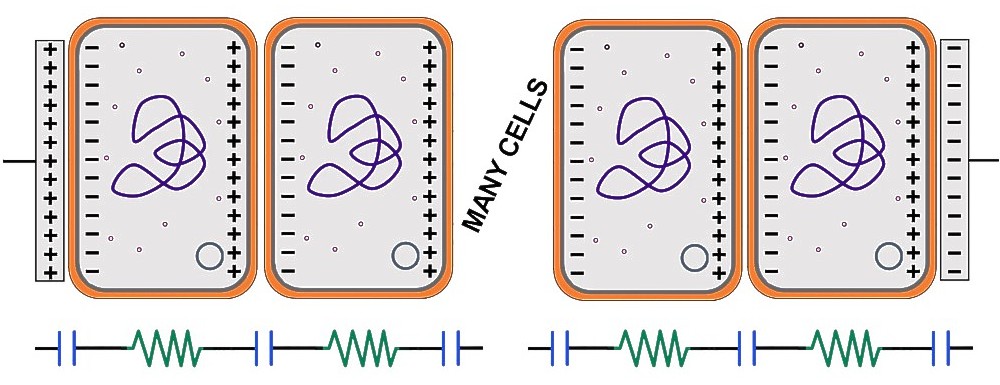
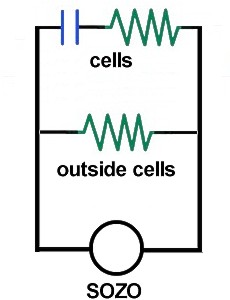
The upper portion is an approximation of the body with contact plates at the extreme left and right and many cells between them. Below is a model using electrical symbols. The blue items are called capacitors and function electrically much like the cell boundaries. The green elements symbolize resistors and here represent the internal resistance of the cell.
It is important to note that just as a map has a certain level of completeness or accuracy that is sufficient for the purpose at hand, the same is true for the electrical model of a human body. A map of a town that included every tree, house, sidewalk, power pole and so on, would be so complicated so as to render it of little value as a road map. So my diagram is just an approximation. Greater detail could be added to get a more accurate result, but at the price of the analysis being more labor intensive.
Circuit theory tells us that when a bunch of elements share the same current, they can be combined. The result is a model of the body
attached to the SOZO that appears like the one at the right. The SOZO applies a voltage to the skin and currents flow through two paths
- one through the conductive fluids outside the cells and another through the cells.
By changing the frequency of that voltage, a determination can be made of the resistance in each path and so, the amount of fluid in
each path.
Spectrum Scanning - It would appear all that must be done is take a reading at low frequencies where the cell path is not a
consideration and another at a much higher frequency where the intercellular insulation is not a factor. While this is certainly simple,
it has some significant real-world shortcomings. To overcome some of these and generate a result with better accuracy, the SOZO makes
measurements at 256 different frequencies between 3,000 cycles per second and 1,000,000 cycles per second.
A simple electrical model of a body being stimulated by the SOZO
One problem is as the frequency rises, the insulating cell membrane looks less and less like a simple barrier. But these changes occur in
documented ways, allowing the machine's software to compensate.
But there is an additional benefit to using a spectrum of frequencies. Knowing the mechanisms involved, the compensated results should fit
an expected pattern. If they do not, something unusual is at play. By displaying the results over a span of frequencies, the expected
pattern can be scrutinized and a judgment made as to whether the results are trustworthy. No such checking could be done if just a low
frequency and high frequency values were presented.
Another consideration is signal size. A current of 0.0002 Amps through a body resistance of approximately 250 Ohms only generates about
0.05 Volts. This amount can be easily induced by sources of electromagnetic interference such as nearby motors and radio transmitters. By
knowing the frequency of the source, what signal frequency to look for is known and other signals more easily rejected.
Cole Diagram - Brothers Kenneth and Robert Cole studied the interaction between electricity and the body. One of the tools they
used was to plot resistive effects versus reactive ones as a function of frequency. Today, any similar efforts are commonly called
Cole plots or Cole diagrams.
These plots generally take the form of the resistive element along the horizontal axis and the reactive portion on the vertical axis.
Kenneth and Robert Cole

These plots tend to appear as the arc of a circle whose center is below the resistive axis. The left axis crossing is the value at infinite frequency and the right axis crossing is at DC or zero frequency.
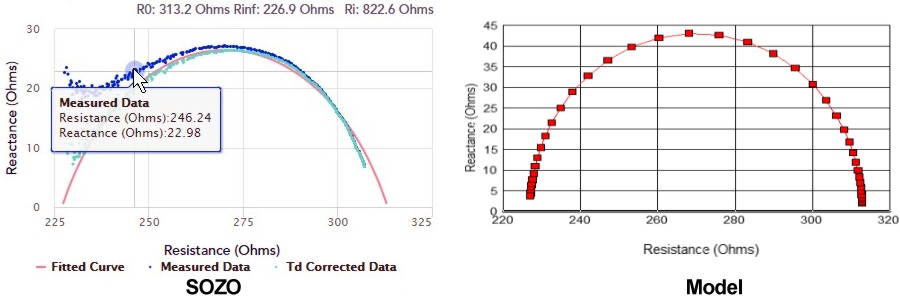
The Cole plot at the left was copied from the online SOZO manual. It shows the measured (dark blue), corrected (light blue-green) and a fitted curve (red) for the corrected data. The Cole plot at the right was generated from an electrical circuit analysis of the simple body model previously introduced. In the latter, the outside cell resistance (Ro) was set to 313 Ohms and the inside cell resistance (Ri) was set to 823 Ohms to match the SOZO's limiting results. This allowed the model results to be compared to the actual (measured) results.
Using the SOZO Machine - While the two previous Cole plots disagree some in terms of the peak reactive value, the two are very
similarly shaped, giving reason to believe that even this very modest model reasonably represents what happens in the human body.
Consequently, using such plots generated from the measured results as a way to judge the reliability of the data is thus supported.
When the machine completes a scan, Cole plots are presented of the measured data for the four limbs and the right and left whole body
(arm + torso + leg). They are then compared to the expected pattern and the software judges them to be of high quality, medium quality, or
poor quality. As can be expected, higher quality measurements correspond to more confidence in the data and the results they generate.
Since most people are fairly symmetrical, the out-of-cell fluid content for the limb at risk is compared to its other-side partner. (If
both are at risk, related values from the legs are used.)
L-Dex - In order to make the SOZO user friendly, software manipulates the results and presents them in a much simpler format.
Impedimed had an earlier machine called the Imp XCA. While it only used a single measurement frequency of 30,000 cycles per second, it
presented results in the form of a Lymphedema Index or L-Dex score. That scoring scheme has been carried over to the SOZO.
The SOZO takes into account the normal differences seen between a patient's dominant and non-dominant arm. It then converts the resistive
difference between the arms into a scale that was correlated with lymphedema determinations made from data using accurate, but not
clinically-adaptable techniques.
A National Library of Health publication states, "The most commonly accepted definition of lymphedema is a 2-cm increase in limb girth or
a 2-cm inter-limb difference, a 200 mL increase in limb volume or a 10% limb volume change." These are four different criteria and even if
the SOZO was a perfect device, it is unlikely to precisely fit any of the four. Furthermore, an excess-fluid situation that causes problems
for one person may not for another. The SOZO manual indicates that a score increase of greater than 6.5 should be considered the point
where heightened vigilance is warranted. However, some cases will occur with a smaller change and some will be acceptable with a greater
increase.
The company asserts that the unit will detect less than three tablespoons of fluid increase and flags about 90 percent of developing
lymphedema cases at an early stage, greatly increasing the likelihood that if they are treated promptly, they will not become chronic.
Results can often be improved if a scan is taken before any treatments begin to provide a high-quality baseline, but patients are rarely
focused on lymphedema immediately after being diagnosed with cancer. But even without such a baseline, the device will be useful to track
changes.
So, as with most diagnostic tools, Impedimed's unit is not the final word, but, instead, is a significant improvement over previous methods
of measuring fluid changes in the body.