
TAKE TWO - 1 May 2026

End of Cycle Four and the Way Forward - After Cycle Three, Dr. Koeneke decided to call an end to the Carboplatin and Taxotere
infusions. So Cycle Four consisted of the Phesgo injection only. The goal remains to root out any cancer cells that may have wandered
away from their origin in her right breast and for Gloria to regain some of the 20 pounds of weight she has lost.
A Correction - In order to get all of the important aspects in a cycle into an update, it is necessary to wait until the cycle is
complete. Then it takes some time to compose the report. While casting about for photos for the Cycle Three report, I inadvertently
grabbed three that were taken during the early part of Cycle Four i.e., the cycle reported here. Those have been transferred to this
update.
Cycle Four Commences - This cycle began on March 25 with a Phesgo injection into Gloria's right thigh. The only reaction noted
over the next couple of days was a slight downtick in her level of energy and one incident of diarrhea.
A trip to Wisconsin had been planned for April 1, with a return on April 14. On April 16, our "German son" Tim was to fly in and stay
with us until he returned to Berlin on April 21. Cycle Five would begin the next day.
The seven days prior to the Appleton trip were pretty uneventful in most regards. Gloria seemed to become more animated day-to-day as
the time passed, but her weight stubbornly hovered between 116 and 117 pounds. Since we would be gone on Easter, we celebrated with
Mariya, Miriam and Diana the Sunday before with one of my ham dinners. Gloria's contribution was a plate of deviled eggs - which
we all forgot to bring out during the meal. Nonetheless, they were appreciated as an unusual dessert!
Gloria's April 24 column covered the events of both the Appleton trip and Tim's visit, and so I decided to plagiarize it for most of
the update covering that period. After, I will discuss what Phesgo is and how it works as it was last mentioned in the 3 November
update - now 6 months ago - and Phesgo was given little space compared to Carboplatin and Taxotere.
Gloria's April 24, 2026 Column -
Bored with myself
I'm usually easily amused - a trait that has served me quite well throughout my life. So I approach each season as if it's the
first time I've experienced it. Leaves turning blazing reds and oranges in autumn? Love it! First winter snow? Ditto! Leaves
greening up and flowers popping up in the spring? Fabulous! Fourth-of-July fireworks and fields full of crops? Feels sweet as home!
However, the past few months have challenged my sense of wonder. At one point in February, I even asked husband Art when the last
time was that I had expressed joy at anything. Things felt "wrong" and I asked myself whether I'd ever feel that wonder and joy
again.
I kept rationalizing that I had a reason for my "funk." Diagnosed with breast cancer in August, I've had various surgeries and
treatments since mid-September, which have collectively zapped my energy and with it, my zest for living.
At some point in March, both Art and I decided a change of scenery and a change of pace were needed. I told people I was bored with
myself and ready for an "adventure" - whatever form that might take.
Art and I had talked about going to Wisconsin, but we weren't sure whether I'd feel well enough to travel. We eventually decided to
fly from our home in Manhattan to his hometown of Appleton. We'd drive back to Kansas a couple of weeks later with the car we had
left in the garage at his family home.
The April 1 flight was routine - a hop from Manhattan to Chicago, a three-hour layover, and a flight from Chicago to Appleton. Art's
cousin Kris picked us up and took us to our home-away-from-home. The vehicle we had left started, but the left-front tire was low,
necessitating a trip to get a tire pump.
Everything in the house was fine, thanks to neighbors across the street who mow during the growing season, shovel snow during the
winter, and check the thermostat every few days during the cold months to make sure the furnace is working.
A couple of weeks before our visit, Appleton had 27.5 inches of snow, the second-highest snowfall on record. That would have been
quite a change of scenery, but I was entirely ok with missing that one! Seeing it piled high in parking lots, even as temperatures
rose well above freezing, was more than enough.
Art went about getting us settled comfortably - putting the thermostat up to warm the house, turning on the water, and turning on
the gas to the cook stove.
Our first evening was great, thanks to Kris's generosity. Knowing we wouldn't be much in the mood to buy groceries or cook, she had
brought us homemade ham-and-bean soup, spaghetti with meat sauce, cheese, bread, pumpkin pie, and other goodies.
Although Appleton was colder than Manhattan and I am not a cold-weather person, I was already enjoying that change of scenery.
We saw Kris several times during our stay and got together with her, Art's cousin Jeff, and wife Lorraine for a meal and lively
conversation. I always enjoy hearing the cousins talk about their growing-up years and telling tales of various family members.
From Appleton, we traveled to Madison to visit daughter Katie and her husband Matt. We ate at a Thai restaurant in what had once
been an ordinary home in a residential neighborhood. Far away from any commercial area, it felt as if we were having supper with a
new bunch of friends. The next day was quite the opposite. The strip restaurant near the university was filled with students. We
chatted with the two good-looking "boys" at the table next to us who plan to be doctors. They had just finished struggling with a
biochemistry assignment.
Friend Jo's farm in a valley in southwest Wisconsin was our last stop. She had just lost her significant other John a week before.
It was a bittersweet time - remembering the good times with him. We liked him a lot, and he and Jo were perfect partners. It is so
hard to accept we won't see him again.
On Sunday, Jo needed a change of scenery, too, so we drove to Spring Green, the location of architect Frank Lloyd Wright's famous
Taliesen home. We didn't see it, but it was a fun town to visit, with several buildings designed in Wright's "organic architecture"
style. Other buildings were more Victorian, with elaborate details around the windows and doors. We spent nearly an hour in a
bookshop. As we finished making our purchases, the sky opened up. Art was going to wait for the rain to stop, but Jo and I were
more in the mood to experience another spring adventure while walking to the car.
The following day involved time on Jo's porch, soaking in the beauty of the emerging spring. The daffodils were blooming and tiny
light-blue and dark-blue flowers were spread throughout the grass, provided an inviting contrast. As evening closed in, the "peepers"
were singing in the wetland reeds nearby, the beavers were chit-chitting in the nearby pond, and the sky was lit up with lightning.
In the nearby woods, owls called to each other. Once we were inside, a thunderstorm arrived, pelting the windows and scaring one of
Jo's cats.
We were reluctant to leave on Tuesday morning, but I was also eager to see what changes we would see in Kansas after being away for
two weeks.
I wasn't disappointed. Peony buds had appeared, irises had begun blooming, the trees had leafed out, and our Flint Hills were
greening.
Two days after our return, "German son" Tim arrived for a four-day visit. A bonus was getting to spend "GG" - Grandma Gloria - time
with granddaughter Diana.
It seemed as if I had been bored with myself for a long time. But family, friends, a scenery change, the arrival of spring, and the
pain of John’s loss had swept that away and reminded me that I was alive and to be thankful.
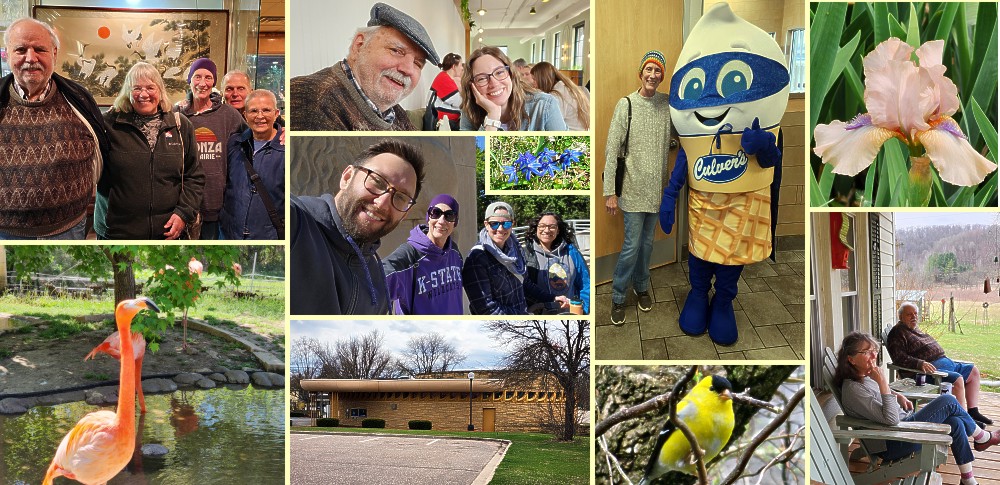
Clockwise from upper-left: Art, Kris, me, Jeff and Lorraine meet for supper; Art and Katie during our Saturday brunch; Culver's "Scoopie" mascot; an iris from the bed near our mailbox; Jo and Art on her porch take in the beauty of spring; a visitor to one of Jo's feeders; Wright-inspired bank building in Spring Green; feathered friend during a trip to the local zoo. Center: Tim, me, Mariya and Miriam during a trip to the local zoo; inset: blue flowers in Jo's lawn.
Traditional Drugs - The chemotherapy drug Carboplatin had its origins in an experiment performed at Michigan State
University in 1965. While looking at the effect of electricity on a particular bacteria, the researcher chose to use platinum electrodes
as it was known to be a relatively inactive material and so unlikely to have an impact on the experiment. A better choice would have been
gold, but the expense would have been much greater.
But the platinum wasn't passive enough, did have an impact, and formed a compound that hindered cell reproduction. This undesired and
unexpected effect has now been used to treat cancer victims ever since.
Taxotere can trace its origins back to the 1960s when the National Cancer Institute began testing over 100,000 plant materials for
anti-cancer properties. A compound that fit the bill was discovered in a West-coast yew tree.
The researchers involved in these efforts certainly deserve accolades for their powers of observation and diligence, but it seems a
bit like looking for a home by wandering about in nature and seeing what you find. What was found might be thought of as a couple of caves
- they work, but not very well. This is medicine from the era portrayed in the Flintstones cartoon.
Phesgo is Different - The drugs in Phesgo are quite different. They are much closer to a modern home where materials are selected and put together in order
to achieve a particular effect.
In order for an animal to continue to live, dead cells or ones that are "over the hill" must be replaced. So cell reproduction is a good
thing. But cancer is too much of this good thing! The problem becomes one of returning reproduction to an appropriate level- to turn it
down, but not off.
An important part of the reproductive system for many body cells are the Human-Epidermal-Growth-Factor Receptor (HER) proteins. All
breast cells have them. Each pokes through the cell membrane, so one end is on the outside and the other is on the inside. When a nearby
cell detects the need for growth, perhaps due to an injury, it creates a protein called a ligand that finds its way to its neighboring
cells. When the ligand reaches an HER receptor, a sequence of events is initiated that results in the receiving cell reproducing.
That's how it is supposed to work.
There are four types of HER cells, cleverly named HER1, HER2, HER3, and HER4. The HER2 protein is different from the other
three, having no known ligand it responds to. Instead, it works as a sort of helper for the other three. So when HER1, HER3, or HER4
are activated by a ligand, it typically pairs with an HER2 to initiate duplication.
But an error in a cell can cause it to generate too many HER2 proteins. Those can then team up with one of the others in the HER family
without the linking provided by a ligand or may even just pair with another HER2 receptor to trigger reproduction i.e., thereby producing
uncontrolled growth.
Both of these actions must be blocked to stop cell proliferation. Phesgo has two chemical components, one targeting each.
Pertuzumab (per-TOO-zoo-mab) blocks HER2 proteins from pairing with other HER family members and trastuzumab (tra-STOO-zoo-mab) blocks
an HER2 protein from pairing with another HER2 protein.
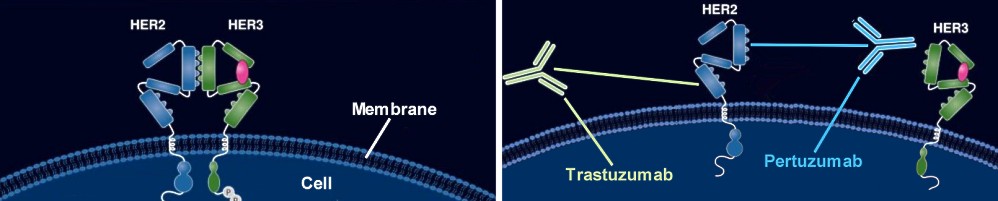
The drawing on the left represents a cell wall with paired HER2 (blue) and HER3 (green) proteins. The pairing will result in cell replication. In the drawing on the right, the pertuzumab antibody will stick to the indicated portion of an HER2 protein, blocking pairing with the HER3 protein. In addition, the trastuzumab antibody will bind to another section of the HER2 protein. This will block pairing with another HER2 receptor.
Immune System Similarity - In many regards, the Phesgo drugs act much as a person’s immune system does to defeat a disease.
Whenever the immune system detects an invader, it looks for some molecule on the rascal's surface that is unique to it. It then creates
what are called antibodies. These are little Y-shaped proteins about one thousandth the size of a red blood cell. Both upper legs of the
Y have molecules that are the mirror opposites of the unique surface molecule found on the invader. If while circulating in the blood,
one of these antibodies encounters an invader, one of the Y legs will stick to that unique area.
This generally blocks the invader from doing whatever it normally does, such as invading a healthy cell.
After a successful invasion is repulsed, the excess antibodies may stay in the body for years. If a person ever encounters the same
pathogen again later in life, the immune system reacts swiftly as these antibodies are already on duty. For a healthy adult, the
accumulated antibodies of a lifetime of fending off threats account for about 1 percent of the blood volume or about the weight of 10
nickels for an average adult human.
A response will come more slowly for an invader never before encountered due to the need for the recognition, antibody-creating, and
duplicating phases to first complete.
Pertuzumab and trastuzumab are called monoclonal antibodies. They are antibodies designed to recognize and lock on to different parts of
the HER2 protein. Pertuzumab blocks HER2 from pairing with the other three HER receptors, while trastuzumab blocks it pairing with
another HER2 receptor.
The accumulation of antibodies at any location invites an attack by the immune system's four types of "clean-up" cells by, in effect,
poisoning and engulfing the cells targeted by the antibodies.
Where the Rubber Meets the Road - It's a big jump from theory to an actual therapy. Ignoring all the subtleties, the principal
problems are to develop the antibodies pertuzumab and trastuzumab - also called Perjeta and Herceptin - duplicate them by the billions,
and figure out how to deliver them.
There are about 120 different known atoms, but only 94 occur naturally. Of these, 20 are common. It only takes 11 to make up 99.9 percent
of the human body. The proteins which make up the bulk of our being are created by chaining these common ones together like LEGO pieces.
Pertuzumab - trastuzumab is similar - has about 10,000 hydrogen atoms, 6,500 carbon atoms, 2,000 oxygen atoms, 1,700 nitrogen atoms, and
40 sulphur atoms, for a total of about 20,000 atoms. Even if we knew how to do it, the process of "building" such a protein atom by atom
would be excruciatingly slow.
Since the only important differences between various human antibodies is the binding head at the Y tips, that is where the effort is
focused. In other words, we'll modify existing antibodies rather than build wholly new ones.
This part, as the Brits say, is a little "fiddly." It involves looking at the target cell's DNA and finding the part that generates the
target part of the HER2 protein. Then the mirror image of the structure is created and, in effect, tacked to an existing antibody whose
tips have been removed.
Now we need the resulting protein in large numbers. It is more than a bit ironic that the device used to achieve this end is a myeloma
cancer cell! But it makes sense. Cancers are efficient copy machines and that is exactly what is needed.
A typical Phesgo injection contains 0.6 grams - the weight of about 10 percent of a nickel - of each of the two antibodies. These will be
injected in the patient's thigh where they will join the body’s normal 50 grams of antibodies that have been collected over a lifetime
of doing battle with diseases. The two active ingredients are dissolved in 10 milliliters of water containing an agent that facilitates
absorption.
This is admittedly very clever. In some cases, tumors that were inoperable have been shrunk to the point they can be surgically removed.
Others have vanished altogether. But there is a price to be paid.
Cancer cells are not the only ones with HER2 receptors and the Phesgo antibodies do not distinguish between the desired and undesired
cells. One organ that relies on healthy HER2 operation is the heart. So, once again, there is no free lunch and a balance must be struck.
Phesgo treatments come with the necessity of monitoring its effects on the heart with a possible need to curtail treatment.
And, of course, there is a dollars-and-cents price tag, although it is more dollars than cents. The price tag for all this clever
chemistry? About $10,000 per injection, or a quarter for every minute between normal three-week injection cycles.
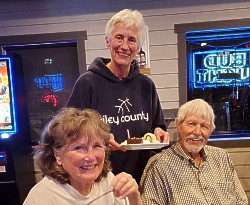
Jo, Gloria, and John last fall
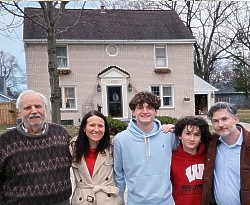
Taylors are Good Neighbors
Update Wrap-up -
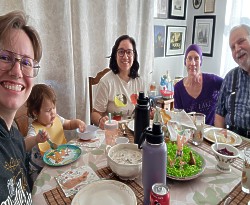
We had an early Easter because of our Wisconsin trip.
We lost Jo's love and our good friend and columnist John Gibbs April 1st.
Hair coming back soft as velvet.
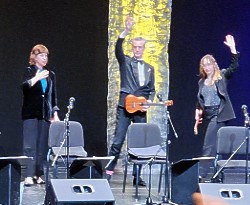
Enjoyed the Ukulele Orchestra of Great Britain again this year!
Neighbors Sarah, Henry, James and Nathan take care of our Appleton digs!
Ukulele Orchestra Second Time
Happy pix-squished Easter
Fuzzy Wuzzy