Kansas Snapshots by Gloria Freeland - October 30, 2026
You rolling river
But one choir piece from my childhood does resonate with me. The music has a haunting and melancholy nature, yet the lyrics are not sung in
a reflective way, but in full voice. The words don't really tell a coherent story, as if they weren't all from the same writer. While the
piece is known by several names, "Shenandoah" is the one most familiar to me.
Hearing it at a recent rehearsal, I was spurred to learn the story behind it. To my surprise, Art was completely familiar with its back
story, having discovered it quite by accident some years ago. While chatting with a woman who had previously mentioned never being in
Art's native Wisconsin, she commented many people of French ancestry must live there.
There aren't, so why would she think that?
It was because Wisconsin has so many geographic names of French origin. Art's family once lived in the city of Fond du Lac. Eau Claire has
the Leinenkugel brewery. Our cottage is near the Nicolet Forest. Prairie du Chien is the upper Midwest's oldest city. Some of my ancestors
lived in Trempealeau County.
Green Bay, the home of the Packers football team, is one of North America's earliest settlements. It was originally named La Baie des
Puants, meaning "stinking bay," due to decaying vegetation in nearby marsh lands. Charles Michel de Langlade, its first permanent
resident, is often referred to as the "father of Wisconsin."
The French influence in North America began about 1640 with trade between those on the northeastern coast and nearby Native Americans.
European-made goods were traded for fish.
While the French were looking for a Northwest Passage to the Far East, the appetite for furs in Europe and Great Britain grew, causing the
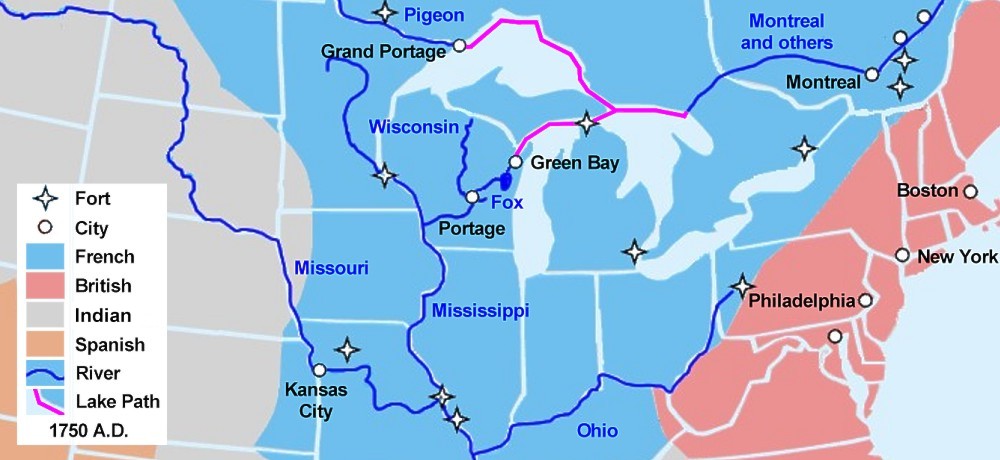
French government to establish trading centers at Quebec and later, Montreal. From there, 40-foot canoes proceeded westward, each paddled by
ten voyageurs - French for travelers. Upon reaching Lake Huron, they hugged its northern shore. Upon arriving at the eastern tip of what is
today Upper Michigan, they would divide.
One group traveled northwest to Lake Superior and paddled along its northern shore until Grand Portage, located where present-day Minnesota
and Canada meet. There they joined other voyageurs returning from canoeing the Pigeon River and its tributaries to the northwest. These men,
with canoes half the size, brought furs obtained from Native Americans along their route in return for European goods obtained from the
Lake Superior paddlers the previous year. Goods were exchanged and the two groups would once again separate, one returning to Montreal
with the furs, while the other paddled into Canada’s interior with more European goods to trade.
The other group of Lake Huron Voyageurs would turn south and enter Lake Michigan, with Green Bay being their initial destination. There,
the mouth of the Fox River provided access to central Wisconsin.
At Portage, the Fox River and the Wisconsin River are separated by only two miles. Carrying their canoes across the gap, voyageurs gained
access not just to upper Wisconsin, but to the Mississippi, Ohio and Missouri river lands as well. Routes were established through New
Orleans, a city that would challenge Montreal's supremacy.
But mostly, the songs were about the highways of their lives - the rolling rivers.
Poor economic conditions in Europe and rising land prices in the East caused Wisconsin's population to balloon from 31,000 in 1840 to a
little more than a million by 1870 - greater than a 3,000 percent increase in just 30 years.
As a percentage of the population, today almost 50 percent of Badger Staters identify themselves as German - the most of all states.
Norwegians are the second largest group at 10 percent. Even these late arrivals outnumber the French, who had preceded them, by more
than three to one.
But those French men, whether searching for a passage that didn’t exist, or furs that did, named places that were important in their work.
Today, these are clues in plain sight of their once-dominant role in a place where they are now virtually absent.
And they left something else as well. They left us "Shenandoah" - a haunting song that speaks to their courage and endurance, but also of
a life filled with seemingly countless hours of aloneness.