Kansas Snapshots by Gloria Freeland - October 23, 2026
Getting nosy
Husband Art recently mentioned he had been getting into nose art. It was hard to imagine that those nose rings and studs so popular with
some of the younger generation was something he was interested in. While they are not my cup-o-tea, they’ve always ranked even lower
with him. He’s not even excited about pierced ears.
While I do on occasion wonder about his sanity - wearing shorts in sub-freezing temperatures - it seems his fondness for nose art was not
an indicator of approaching senility. The nose in this case was not a proboscis, but referred to the leading part of an airplane.
With that clarification, my mind went to those images of scantily-clad well-endowed females that often graced the fuselages of World War II
aircraft. But after all those years of researching the lives of our service men and women of that era, why this interest now?
It was something that caught his eye while we were waiting in the Manchester, England airport to board our plane for
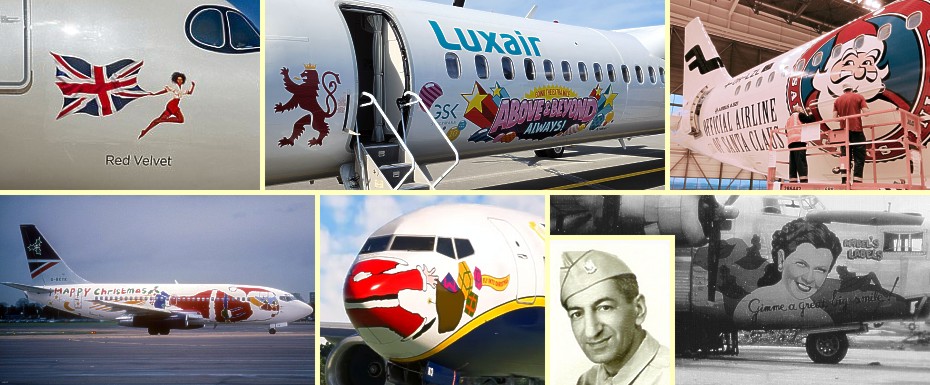
Luxembourg. The plane at the next gate had an image near the nose of a female runner trailing a flag as if she had been in a race
representing her country. He was surprised seeing it as he was under the impression that nose art was a thing of the distant past.
But when we deplaned in Luxembourg, he noticed our plane also was painted with far more than the carrier's logo and color scheme, prompting
him to take a photo.
This sparked my doing a bit of digging and subsequently learning a new word - or more accurately, expanding my understanding of one I
already knew. This country girl thought a livery was a place where horses were kept. It might be, but it isn't limited to horses. The
word once referred to what was provided to people by their employer or master in the form of food, shelter and care. Later, when
associated with our animals, a livery stable became a place where their needs were attended to. This made the blanket covering a horse
part of its livery. The term morphed further to be applied to the outside covering of any mode of transportation. So while it is
somewhat of an "insider" term, livery now refers to the exterior decoration on a plane or any other vehicle of transportation, including
the paint job on an automobile.
The livery of our Luxair plane was the result of a partnership between the country of Luxembourg's national airline and the law firm
GSK Stockmann. The international firm’s local office recently celebrated its 10th anniversary in the country. While that sort of
public-private partnership may seem a bit odd to us, Luxembourg is an international powerhouse when it comes to commerce and business,
linking those two just as wheat and Kansas are connected.
In true rabbit-hole fashion, my interest expanded from nose art to the livery of airplanes in general. The earliest planes had
cloth-covered exteriors, and painting became essential to protect the cloth. Stunt pilots chose colors and patterns to make their planes
easier to see, while militaries made selections that camouflaged their aircraft and made it easier to differentiate friend from foe.
When airplane skins became predominately aluminum, an unpainted exterior became common as it was rather eye-catching. But paint also
protects metal from corrosion, reducing maintenance. The paint on a modern passenger aircraft like the Airbus 380 can weigh as much as
six passengers and can take several dozen workers a couple of weeks to apply. A paint job is even more costly if the plane had been
previously painted as the old paint first has to be removed. Chemical strippers can be used on metal-body planes, but composition body
materials, now common on newer aircraft, are damaged by them, requiring the old paint to be sanded off. Even metal body planes are
initially lightly sanded to allow the stripper to more effectively penetrate the old livery.
Whether with cars or planes, a new paint job is a multi-step process. A metal-based vehicle will first need an anti-corrosion treatment. A
base coat follows upon which the layer we see is then applied. A protective coating is then added. Liveries with intricate patterns may
also involve stencils and/or stickers.
A commercial passenger plane is typically repainted every five years or so at a cost of $200,000 - more if the design is intricate. Portions
may be hand painted.
During World War II, camouflage painting was initially popular with the military, but midway through the war it was discovered that the
plain metal was just as difficult to see once the plane was in the air. The reduced weight of the unpainted fuselage increased range, while
decreasing fuel consumption - factors more important than aircraft longevity.
The practice of adding individualized art during the war was apparently a spontaneous reaction in individual units. Plane crews sometimes
collectively decided on a name or image, but the aircraft commander, who was frequently the pilot, might make the decision on his
own. Almost every base had soldiers who had been artists as civilians, so that was not a problem.
While planes like the Memphis Belle and Enola Gay are iconic, many planes didn't have nose art. The practice varied widely, due to a
variety of factors, such as the frequency with which crews switched planes.
While personalizing aircraft was never officially condoned, today our military tightly controls what is placed on the outside of a military
aircraft. Some are painted with special radar-evading coatings and its effect would be materially degraded by adding personalized livery.
As for Art, he's sticking with his traditional "look" of jean shorts and sport shirts, leaving nose art for the younger crowd.