Kansas Snapshots by Gloria Freeland - October 9, 2026
"All quiet ..."
Husband Art, his cousin Kris, and I decided on our most recent France trip to visit the Meuse-Argonne World War I and Lorraine World War II
American cemeteries.
Despite having visited similar places before, I am always struck by their beauty and peacefulness. The lawns, bushes, trees, and flowers
are meticulously and lovingly cared for, creating a sense of reverence in visitors, who walk slowly and speak quietly.
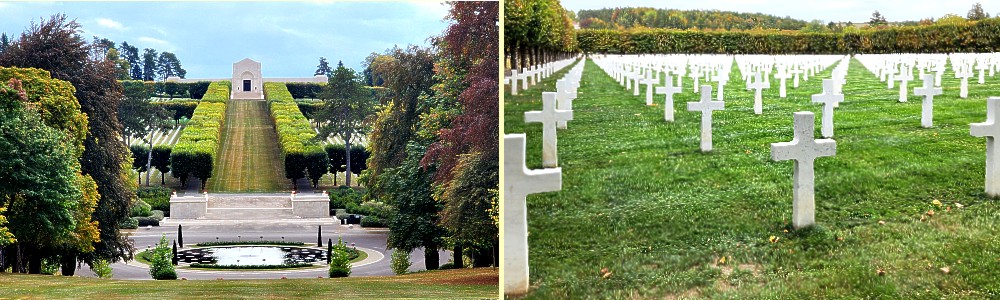
Meuse-Argonne American Cemetery (l-r): view from the reception building looking toward the chapel; one section of the
graves. The somewhat unusual colors are the effect of the coming autumn and an exceptionally hot and dry summer.
The cemetery near Argonne is the largest American burial ground from World War I and honors 14,246 dead. The Lorraine cemetery near St.
Avold is the biggest American graveyard from World War II, commemorating 10,482 war casualties. The cemetery at Colleville-sur-Mer
near the Normandy beaches is better-known, frequently appearing in the news as the June 6 D-Day anniversary approaches.
Before March 4, 1923, care of the graves of our soldiers and the related monuments was handled by the War Department, On that day, President
Warren Harding signed legislation creating the American Battle Monuments Commission (ABMC). Soon after, Congress directed ABMC to construct
memorial chapels in the eight permanent military cemeteries in Europe. This was followed in 1929 by Congress authorizing payment for
transportation and lodging for mothers and widows to visit the overseas cemeteries where their loved ones lay. From 1930-'34, 6,700 accepted
the invitation.
Then, in 1934, President Franklin Roosevelt issued an Executive Order that shifted the responsibility for the management and maintenance of
such sites to the ABMC.
World War II casualties created several hundred temporary American burial grounds around the world. In 1947, the Secretary of the Army and
the ABMC selected 14 additional sites in foreign countries to become permanent American cemeteries.
The commission now operates and maintains 26 cemeteries as well as 31 memorials, monuments, and markers in 17 nations. While the land
remains part of the host country, the use of it has been granted in perpetuity to the United States free of charge or taxation. The U.S.
flag flies over most of them. Three of the memorial sites maintained by the ABMC are within the U.S.
Today, 207,000 Americans from the two world wars are interred in ABMC cemeteries. In addition, 750 from the Mexican-American War are
buried in the Mexico City National Cemetery; 5,500 who died during the construction of the Panama Canal are in the Corozal American
Cemetery; and 8,800, who died from various military actions in the Philippines, are in the Clark Veterans Cemetery. These too are managed
by the ABMC.
Cemeteries have "Walls of Honor," containing the names of those missing in action. If the person is later found, a bronze rosette is
added next to the name.
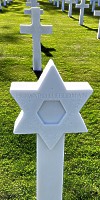
Each grave is marked by a headstone of white marble - a Star of David for those of the Jewish faith and Latin crosses for all others.
Each stone has the person's name, rank, branch of service, home state, and date of death. "Here Rests in Honored Glory a Comrade in Arms
Known but to God" is inscribed on the headstones of Americans whose remains couldn't be identified.
In addition to landscaped grave areas and non-sectarian chapels, some locations contain sculptures, fountains, battle maps, and exhibits.
Star-of-David headstone in the foreground with a Latin cross headstone behind
The visitor center at the Meuse-Argonne cemetery had an exhibit with various personal items that belonged to the fallen. It also had displays featuring Medal of Honor recipients buried there. Lawrence Bleckley of Wichita, Kansas is one of them. German gunners shot down his plane while he was delivering rations to a stranded battalion after being told not to make the attempt. Both he and his pilot, Harold Goettler, were killed. Goettler also received the medal.
Marion G. Crandell was another. A French teacher from Iowa, she volunteered with the Young Men's Christian Association to provide food
and hospitality to soldiers at a canteen. She was the victim of a bomb.
Another display highlighted Gold Star Mothers and Widows. It was the custom during World War I to hang a rectangular red "service flag"
in the windows of their homes if the family had a member in the service. A smaller white rectangle in the center served as the
background for blue stars, one for each person serving. The stars for persons who lost their lives were changed to gold.
Flag for a family with a single member in the service
(Wikipedia)

The ABMC has about 400 full-time civilian employees, including cemetery superintendents, landscaping and security staff, and others who greet visitors.
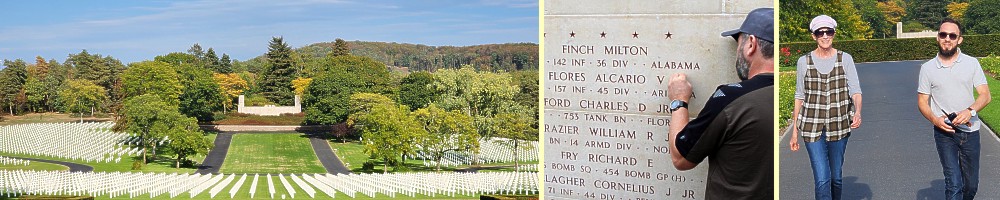
Lorraine American Cemetery (l-r): View from the entrance; workman adding a rosette to the name of a previously-missing soldier,
indicating he has been found; speaking with Max Heidet. (middle image: stripes.com)
At the Lorraine cemetery, some 20 staff members care for the grounds. We spoke with cemetery associate Maximilien Heidet. In addition to
other duties, at the end of the day after "Taps" is played, he lowers and carefully folds into tight triangles the two U.S. flags that
flank the huge chapel. He said a typical flag lasts about three months, depending on the weather. When a flag is withdrawn from service, it
is saved or sent to an appropriate organization for display.
Art and I have spent countless hours over time gathering the stories of those who gave, in part or in whole, their "tomorrows so we can
have our todays." Sometimes our searches lead to visiting small rural graveyards, where the fallen lie among family, friends, and neighbors.
The shape of the markers, their inscriptions, and placement vary widely.
On other occasions, such as our recent visits, the person lies with comrades in a far-from-home land in a site marked by uniformity and
precision.
Perhaps it is my age, but this time as I looked out at the Meuse-Argonne cemetery's mass of graves, my usual sadness was tinged
with something else. These men fought in the "war to end all wars," only to have others do it again just 21 years later. And wars are
still being waged.
That "something else" was anger - anger that humankind can be so foolish.
Suddenly, with row-upon-row of markers spread out before me, the quiet was broken.
"People are stupid!"
Kris's three words had cut to the core. They were not an indictment of those whose graves lay before us, but of how we don’t seem to learn.
Comments? [email protected].
Other columns from this year: Current year Index.
Links to previous years are on the home page: Home