Kansas Snapshots by Gloria Freeland - October 2, 2026
Magyar-Cymru
When I hear the name Woodstock, my mind is immediately awash with thoughts of the uber-famous folk rock festival that took place 57 years
ago. This is despite the fact I have never been to Woodstock and the famous town of 5,000 or so inhabitants is, in reality, 60 miles
distant from the actual concert site.
In a somewhat similar fashion, all of the bits and pieces in last week's column about our visit to the little village of Montgomery, Wales,
population 1,300 or so, could have easily been overwhelmed by one odd fact about the town, part of which isn't even true!
This part of Montgomery's story begins with an event that happened in 1857 in Hungary, more than 1,000 miles away. The famous Hungarian
poet János Arany had been asked to compose a poem glorifying Austria's then-monarch Franz Joseph. But while Franz Joseph was a hero to most
Austrians, the king's military crushing of Hungary's bid for independence in 1848 had not endeared him to many Hungarians, including Arany.
To him, the request smacked of the ancient tradition in Wales where it was customary for a leader to literally employ a bard solely for the
purpose of singing the leader's praises. The bard was, in effect, a sort of yesteryear publicity man. Arany wanted nothing to do with that
role.
Yet openly saying "no" to the Habsburg ruler was not a wise move. So he instead composed a poem about something far removed from current
events, but had a subtle message understood by his countrymen. The poem was called "A Walesi bárdok," or "The Bards of Wales."
The focus of the poem was the request in the 1200s by England's King Edward I to 500 Welsh bards to sing Edward's praises to their Welsh
kin just after he had succeeded in subjugating them. Unlike Arany, who merely dodged a request from his king, the bards flatly refused. In
response, Edward had them all burned at the stake. The setting for this event was - you guessed it - Montgomery.
But art is not obligated to reflect reality. There isn't one shred of evidence that anything of this nature ever happened. However, this
fanciful tale of protest resonated with Arany's compatriots. Over time, and particularly when Hungary gained its independence after World
War I, the poem became so popular that it became mandatory reading material in every school in the land and remains so to the present day.
Students are often required to memorize parts and recite them while standing before the class.
It also had the unintended effect of having every Hungarian be familiar with a certain little village in far-away Wales.
While this quirky situation is somewhat amusing, the whole matter took a dramatic turn recently. In 2011, famous composer Sir Karl
Jenkins, himself a Welshman, composed a piece based on the poem. It debuted in Wales in 2012 and gained an even larger audience the
following year when it was aired by the British Broadcasting Corporation.
Jenkins' efforts raised the awareness of the tale in Britain, but the real credit for what followed belongs to Balint Brunner, a person
who could hardly have been better suited to the task. He was born in Budapest, but his family moved to England when he was 12. His
university studies were in - of all things - public relations! After graduation, he practiced his craft with the giant European airplane
manufacturer Airbus.
Exactly what prompted him to promote the Hungary-Wales connection is unclear. Perhaps it was him moving to the small North-Wales village
of Penmaenmawr. In a 2022 article for the BBC, Brunner said:
I am one of the millions of Hungarian pupils who have said the words of the poem in front of the class.
Little did I know at the time that I would one day be captivated by Wales, start learning Welsh and launch Magyar Cymru to build cultural
bridges between Wales and Hungary.
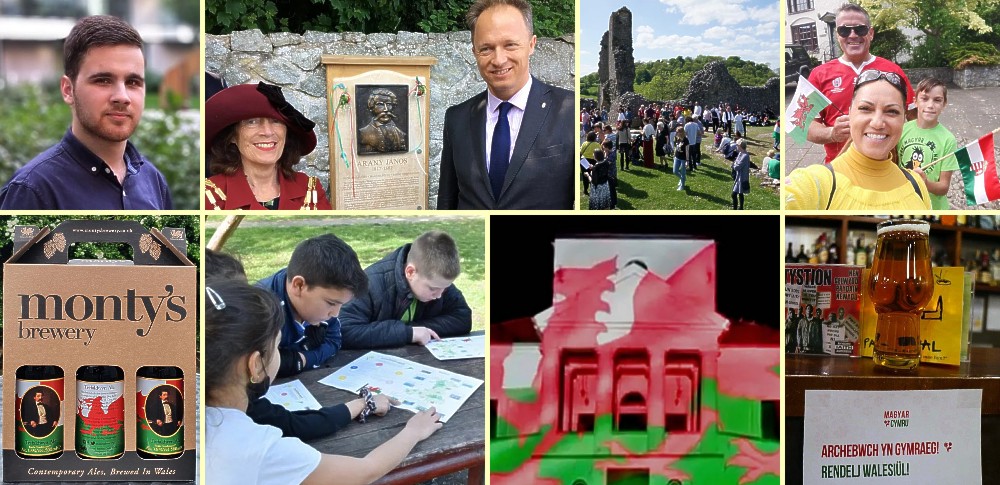
The not-for-profit organization was begun in 2019. Magyar is the Hungarian word for Hungary and Cymru is the Welsh word for Wales. Its goal
was to more closely connect the two countries.
This led to Montgomery hosting a day celebrating all aspects of Hungarian culture in 2022. Hungarian ambassador Dr. Ferenc Kumin unveiled
a plaque bearing Arany's likeness in the village park. The words were in Hungarian, Welsh, and English.
Kumin said,
Every single Hungarian pupil has to memorise this poem and with that we also memorise the name of Montgomery, but we always wonder if it
is just part of a mythical world created by our beloved poet János Arany.
During the day, musicians around town played Hungarian music, goulash was served at the local café, some dressed in traditional Magyar
dress, and many flew Hungarian flags from their homes. The celebration drew visits not just from locals, but from people across Britain.
Those with Hungarian roots were particularly interested and visitors from Hungary were also there.
Jill Kibble, Montgomery's mayor, said:
This was the first time in the 165-year-old history of The Bards of Wales that hundreds of Welsh and Hungarian people gathered among
our beautiful castle ruins. This special day has forever cemented the friendship between our tiny town of Montgomery and the entire
country of Hungary.
But this is not a one-sided affair. The day in Hungary has for some time been celebrated by groups singing songs in Welsh. Welsh flags are
projected on buildings. The connection is promoted by such organizations as the Liszt Institute, named for the famed composer Franz Liszt.
The Hungarian president took part one year. Hungarian choirs have competed at the annual Eisteddfod in Llangollen, winning the "Choir of
the World" competition in 1989.
Each May a day is designated for the official Wales-Hungary friendship day celebration and the connection between the two is growing.
So, Montgomery is a small Welsh-border village, but it is part of a much-larger story.