Kansas Snapshots by Gloria Freeland - September 25, 2026
A day on the border
A few years ago, friends Paul and Debi settled into a rural cottage not far from the Welsh-border village of Montgomery. With their kids
grown and on their own, Paul fills his days as a tradesman who can do anything from hanging a door to renovating a room. Debi teaches
piano and makes stained-glass art pieces and paintings.
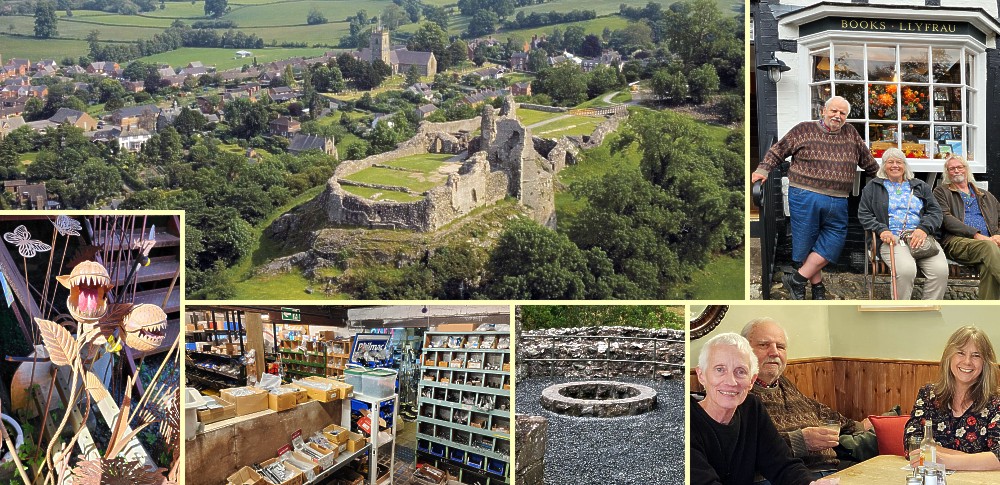
Last Friday, husband Art, his cousin Kris, and I visited them, our place of meeting being the Castle Kitchen restaurant in the village
center. It occupies two floors of an 18th-century townhouse and offers an assortment of wonderful homemade soups, sandwiches, salads, and
pastries. Debi has a shop for her art in one of the rooms upstairs.
While the United States is busy celebrating its 250th anniversary this year, Montgomery is more than three times older, being founded in
1223. Its age was immediately evident even before we arrived. From several miles away, we could see its castle sitting on a prominent high
finger of land just northwest of the town. Only a small fraction of the original structure remains. Its walls might have resisted centuries
of weathering, but couldn't survive the scavenging by locals looking for building materials. The moat is now filled with grass rather than
water. It’s the site of celebrations and Shakespeare plays, rather than a stronghold against enemy armies.
The village buildings are peppered with plaques calling attention to events that happened in them centuries ago, written in a style that
makes them seem as if it all happened just yesterday.
But while words like quiet and bucolic certainly apply, as they would to any number of places along the border between England and Wales,
this village does have several unique aspects.
One is a small bookshop, which has mostly tomes related to local topics, places and people, including an autobiography by Welsh tenor Aled
Wyn Davies, who also farms nearby. We had heard Davies perform with Welsh tenor Rhys Meirion in 2018, and Art thought it would be a fun
read.
One small problem immediately arose. Opening the cover, he discovered it was written in Welsh! His great-grandfather was the last family
member to understand the language.
Outside the shop, I examined a planter filled with small red, white and pink flowers that resembled pinwheels. Having never seen anything
quite like them, I activated my phone's recently-installed "Seek" app. Moss phlox! Funny how things like that can be so satisfying.
Another unusual Montgomery "landmark" is a hardware store, established in 1892 as R.H. Bunner. It's now owned and managed by Bunner's
granddaughters and other family members. It sells seeds and bulbs, tools and traditional hardware items, wood-burning stoves, kitchenware,
toys, gifts, garden furniture and supplies, lawnmowers, bikes, and various other odds and ends. Outside, there is an old petrol - what we
call gasoline - and a diesel pump waiting for anyone who needs a fill. Besides the age of some offerings, there is the quirky presentation.
There are so many nooks and crannies that it's easy to literally become lost. It is both a store and a maze.
While Paul, Kris, and I were meandering through Bunner and Debi was attending to her shop, Art made his own discoveries. One was the
so-called "Robber’s Grave" in the St. Nicholas churchyard cemetery. He was alerted to its presence by a local who saw him wandering about.
It seems in 1821, John Davies was convicted and hanged for highway robbery. Steadfastly proclaiming his innocence, just before his demise,
he asked God to prevent grass from growing on his grave for 100 years as a sign to all who passed by of his unjust conviction. Apparently
his wish was granted, although Art couldn't help wondering if the sparseness of the grass might have had something to do with the large
old tree which shades the grave.
Another unique aspect of the village is actress Julie Christie of "Dr. Zhivago" fame bought a farm just outside the village in the early
1970s and continues to split her time between it and a place in London.
It started to rain, so Paul, Kris, and I headed back to Castle Kitchen, where Debi joined us for cakes and tea. I opted for hot chocolate
and homemade carrot cake.
We eventually caught up with Art, and the five of us drove up to the castle car park. It was cold, wet, and windy, yet somehow that added
to the "atmosphere" of the castle ruins. Without the need to keep a sharp eye for invading outsiders, we could enjoy the stunning views of
the village and surrounding countryside.
King Henry III ordered the construction of the castle in 1223 to defend the site from the "troublesome" Welsh locals. To strengthen the
nearby economy and consolidate English control, the village of Montgomery was planned alongside the castle.
The castle's "Inner Ward" was built as a final line of defense. The walls there were the thickest and there was a well dug through solid
rock, to a depth of 210 feet. Paul noted that despite the recent drought, the well still held water.
After walking around a bit, we were ready to get out of the wind and rain. Paul and Debi invited us to their home for tea and
conversation.
As the light began to fade, we three visitors reluctantly headed to our car to begin our 45-minute journey to Llanrhaeadr - our home away
from home.
An enjoyable day may be the consequence of it having a singular outstanding event, while others are more an assemblage of small, yet
pleasing ones. This had been one of the latter.
However, there was one item I chose to omit here. It deserved a column by itself. Stay tuned!