Kansas Snapshots by Gloria Freeland - September 18, 2026
Bore da - Good day
While speaking with friends Lins, John and their son Owain recently, John remarked that the drought-created silage shortage this year
would be hard on Welsh farmers, if the winter was cold.
"Of course, it will be good for Owain if it is," he added.
Owain smiled. A bad winter would be good for his firewood business.
Some things are like that - good and bad at the same time.
When my Swedish cousin Lars visited a few years back, he mentioned how at a meeting of his company's employees from across the world,
their boss began by saying, "We all speak a common language - bad English."
A common language is a good thing when it helps us communicate. The dominance of English is a testament to how the once world-wide
breadth of the English empire and U.S. economic strength have made our language the one needed to navigate easily in the modern world.
Today, many children, whose first language is not English, begin receiving lessons in our language in kindergarten and sometimes before.
But different cultures view life in different ways and the words of those cultures include elements unique to those viewpoints. The loss
of a language doesn't just dilute a culture, but may cause a loss of its point of view as well.
The German word "Gemütlichkeit" - geh-MOOT-lick-kyte - carries elements that don't translate well into English. This is also true for
the Danish "hygge" - HOO-ga. Both are similar to our term for belonging, but they go beyond, including a profound sense of coziness and
peace of mind.
The Welsh “hiraeth” - heer-eyeth - is another example that has no direct English translation. It combines elements of homesickness,
nostalgia and longing, interlaced with acknowledgment of a loss - of place, time, people, traditions, or language.
So while better communication is facilitated by a common language, many people are not willing to watch their native language and its
related culture disappear. We have seen this firsthand on our trips to Wales.
The Laws in Wales Act of 1535 made English the language of the courts and administration. It excluded people who used only Welsh from
holding certain public offices. In some schools, Students who spoke Welsh were reprimanded by placing around their necks
a placard with the words "Welsh Not." An 1847 British education report said "... The Welsh language is a vast drawback to Wales, and a manifold barrier
to the moral progress and commercial prosperity of the people. It is not easy to overestimate its evil effects. ..." The report for many
years deeply affected England's impression of Wales, and that of the Welsh toward themselves.
So while in 1921, Wales recorded 922,100 Welsh speakers, by 1981, that number had fallen to 503,500.
But Welsh has experienced a resurgence as the result of a concerted effort by the Welsh people. Initially the changes were small, such as
allowing bilingual road signs in 1965. Then communities lobbied for additional changes and challenged exclusion. Educators built curricula
in Welsh and politicians advocated for new laws. In 1982, Sianel Pedwar Cymru - Channel Four Wales - named S4C, began broadcasting as a
Welsh-language TV channel. The Welsh Language and Education Act of 2025 added a legal framework intended to strengthen Welsh-language
education.
The 2025 Welsh Annual Population Survey estimated 844,300 Welsh speakers or 27.3 percent of people aged 3 and over. The national strategy,
Cymraeg 2050 - Welsh 2050 - has set a goal of one million Welsh speakers in Wales by that year.
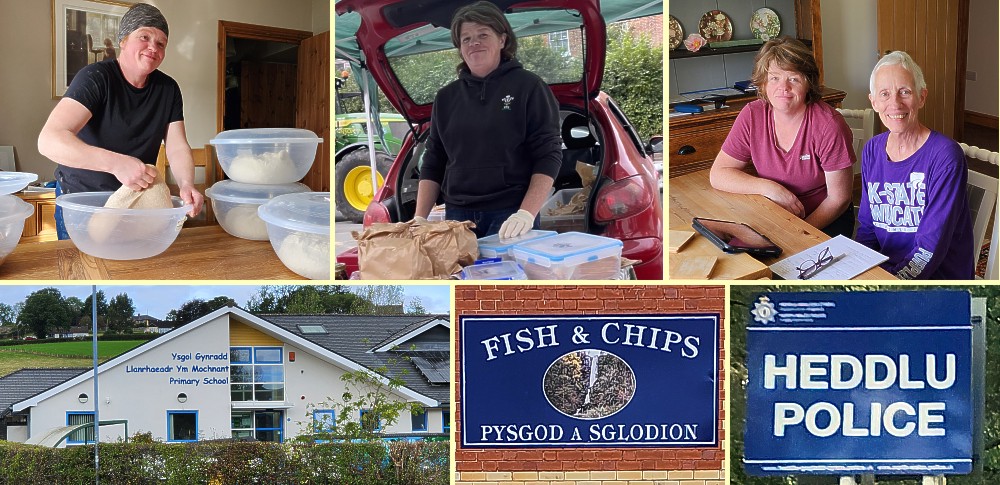
In June, quite by accident, Lins became part of the effort to support the Welsh language. For years, she has gone to bed early on
Wednesday nights to awaken in the small hours of Thursday to bake bread for her customers at the market held later that morning in nearby
Llanfyllin. Vikki Nelson, a consultant for the uTalk language application, approached Lins after hearing her speaking with customers, and
decided she would be a good exemplar of North-Wales Welsh.
In an August issue of the (Powys) County Times, Nelson said, " ... there was Lins chatting away in Welsh to customers with such a warm,
friendly manner, I knew she'd be excellent as our voice artist."
Lins was also quoted in the article.
I've never been asked to do anything like this before, but am more than happy to help. The North Welsh dialect tends to be overlooked
in favour of the Southern one, but it has some different words and a different accent so it'll be lovely to give it the recognition it
deserves.
The London-based uTalk, which has specialized in language learning for more than 30 years, offers more than 150 languages, including
Hawaiian, Zulu, and Quechua. The application uses recordings of native male and female speakers to help users learn around 4,500 practical
words and phrases.
Lins showed me on her iPad what the translation portion of the app looks like. It displays images and guidance notes for specific words in
English in many different categories, including greetings, food and drink, school, farming, gardening, leisure activities, weather,
currency, time and date, etc. The online program shows Welsh translations of certain words and Lins either concurs or sometimes changes
them to reflect what someone from North Wales would say. A few examples include the following:
- school - ysgol
- 2 o’clock - dau o gloch
- butterfly - gloyn byw
- fishing - pysgota
- spade - rhaw
Lins has still more words to translate. Later on, recording will take place in a nearby studio.
She smiled and said she's glad to do her part to preserve the language she learned as a youngster and uses every day in her family home.
Nos da - Good night!