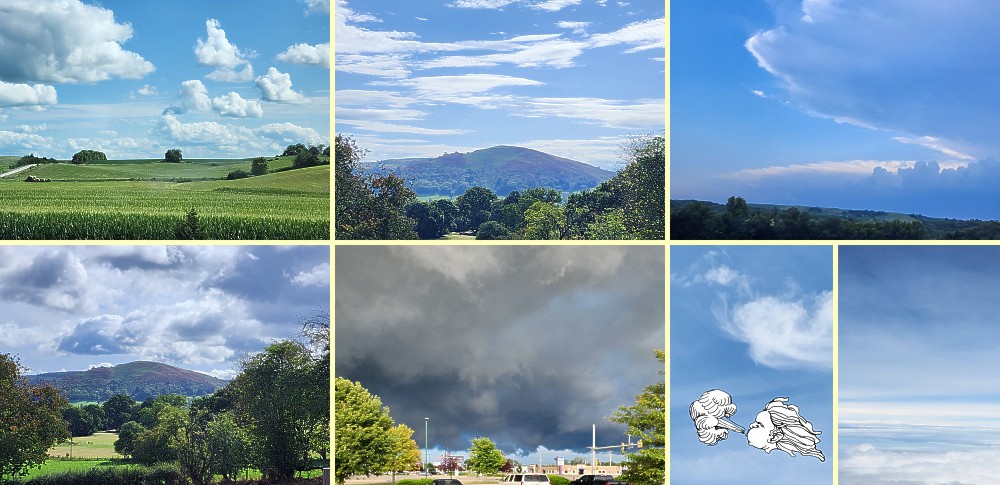
Kansas Snapshots by Gloria Freeland - September 11, 2026
"I really don't know clouds at all"
It seems I've always been a sky watcher. It might be because I grew up on a farm and dad was constantly looking at the clouds to see
whether he thought it was going to be a hot, dry summer day or one that would bring much-needed rain for our crops. Mom's interest was more
that of the artist. She would find patterns in the wispy, billowy ones that drifted across the sky or the threatening ones that seemed to
hang over us.
I'm sure I wasn't unique, as most kids probably spend a lot of time gazing upward, trying to find faces and animals in the clouds' shapes
- prompting adults to tell us to "Get your heads out of the clouds."
I must take after both parents because I like to predict what kind of weather the clouds might foretell, yet I also see their innate beauty.
And I don't just enjoy them from the ground looking up. When I'm in an airplane, I find them particularly awe-inspiring - and sometimes
scary. Going through ominous dark clouds wondering whether a storm will toss the plane around makes me uneasy. One time on a trip between
Denver and Kansas City, the pilot informed us there really was no reasonable way to avoid a storm ahead, so we flew directly through it.
It was the only time I have seen lightning pass between clouds just outside the plane's windows.
I like it best when we rise above them, making it seem as if we're floating on cotton balls.
I didn't know there were other "official" cloud nerds out there until I stumbled across an article about International Cloud Appreciation
Day, celebrated on September 11. On this date, people around the world are encouraged to contribute a photo of their sky to the Cloud
Appreciation Society's Memory Cloud Atlas. The society now includes more than 60,000 members in 120 countries.
The society was founded in 2005 by British author Gavin Pretor-Pinney. He encourages people to "look up, marvel at the ephemeral beauty,
and always remember to live life with your head in the clouds."
Along with writing books, Pretor-Pinney is a journalist and was the co-founder of Idler magazine, a publication that argues for the
importance of down time in creative thinking. But he’s certainly not an idler himself. He's won the Royal Society Winton Prize for Science
Books, has presented television documentaries for the BBC and Channel 4, and is a Visiting Fellow at the Meteorology Department of Reading
University.
I decided to buy his book, "A Cloud a Day" - not only to learn something about clouds, but to share it with my British friend Jan, who
often points out particularly unusual formations.
The book has photos by amateur cloud enthusiasts, satellite images, paintings, sketches, poetry, quotations, and tidbits of cloud science.
In the introduction, Pretor-Pinney says,
... Each of the 365 clouds in this book, no matter whether it was spotted by an astronaut aboard the International Space Station, an
old master of the Dutch Golden Age, or a member of the Cloud Appreciation Society from their backyard, should be thought of as a reminder.
Each cloud is a tap on your shoulder, prompting you to look up, take a breath, and unfetter your thoughts from earthbound concerns. ...
I liked the combination of scientific and artistic snippets in the book. For example:
- Pouch-like lobes of cloud are known as "mamma," from the Latin for "udder" or "breast."
- Lacunosus clouds, derived from the Latin for "full of holes" - are "like gazing up at soap suds beneath a warm bubble bath."
- The official name of the public sculpture in Chicago's Millennium Park - almost universally known as "The Bean" - is "Cloud Gate"
because its shiny stainless-steel surface mirrors the clouds and the sky.
- Hopi tribal groups in Arizona inscribed symbols, some dating back to the 1200s, at Echo Cliffs on their pilgrimages to the Grand Canyon.
One clan carved a row of triangular shapes with lines beneath to depict raining clouds. Historians refer to them as the Cloud Clan.
- In Saul Bellow’s 1959 book, "Henderson the Rain King," he wrote, "We are the first generation to see the clouds from both sides. What a
privilege! First people dreamed upward. Now they dream both upward and downward. This is bound to change something."
Singer-songwriter Joni Mitchell referenced this quote as inspiration for her 1967 hit, "Both Sides, Now."
Rows and flows of angel hair
And ice cream castles in the air
And feather canyons everywhere
I've looked at clouds that way
But now, they only block the sun
They rain and they snow on everyone
So many things I would've done
But clouds got in my way
I've looked at clouds from both sides, now
From up and down, and still somehow
It's cloud illusions, I recall
I really don’t know clouds at all ...
Husband Art once had a dentist whose office was filled with fossils. When Art asked about them, he said, "I’m the guy who loves fossils,
but doesn't know anything about them." I could relate. I love clouds, but "I really don't know clouds at all."