Kansas Snapshots by Gloria Freeland - August 14, 2026
"This could be Rome"
In the second century when the Roman Empire was at its peak, it stretched from Spain in the west to Iran in the east and Egypt in the
south to Scotland in the north. While the European portion collapsed more than 1,500 years ago, remnants remain in many places to delight
us curious tourists.
In England, we've visited Hadrian's Wall near the Scottish border and the amphitheater in Chester. Germany has a bath complex, an
amphitheater and the Porta Nigra - "Black Gate" - in Trier alone. The beautiful mosaic floor uncovered by a local farmer in Nennig looks
as if it were recently laid. Metz, France has aqueducts and other Roman sites sprinkled around the city and nearby countryside. We
recently added another to our list.
On June 21, husband Art and I collected our friend Jan, and in half an hour, we were at Wroxeter Roman City about two miles southeast of
Shrewsbury. It proved to be one of the hottest first-day-of-summers on record. While the high was only in the upper 80s, the sunlight was
intense, so even this Kansas girl couldn't linger for long in the ruins.
Neither Jan nor Art are fans of heat, so the first order of business was to buy Magnum ice cream bars from the museum's gift shop. We sat
on the veranda on the southwest side of the museum with the intention of savoring our cool treats, but the heat meant we were forced to eat
them quickly.
Two fellow tourists sat on a nearby bench. Wiping the sweat from his brow, one commented, "THIS could be Rome!"
Two others soon joined us, dog in tow. The boy prodded the man to get up, but the man said it was too hot for the dog. When I looked at
them, it appeared the dog was quite comfy.
While it was pretty warm to be traipsing around the ruins, traipse we did.
The Romans built a fort in Wroxeter in the mid-first century, the city being established about 50 years later. It would become one of the
largest cities in Roman Britain and, at its peak, covered 192 acres - about the size of Pompeii, Italy.
Jan and I toured the small museum, where glass, pottery, jewelry, tools, weapons, amulets, and other artifacts were displayed. These objects
and thousands more found during excavations show what life was like in Wroxeter during the second to fourth centuries.
It was the "Old Work" - the only wall remaining of the expansive bath complex - that first attracted archaeologists in 1859. Excavations
continued into the early-20th century, as well as in the 1970s to 1990s. More recently, archaeologists have used non-invasive techniques,
such as creating digital maps with drones using LiDAR (Light Detection and Ranging) scanners.
After being oriented by the museum displays, I walked about the periphery of the ruins, reading the interpretive markers as I went. The
excavated area is just one of the original 48 city blocks.
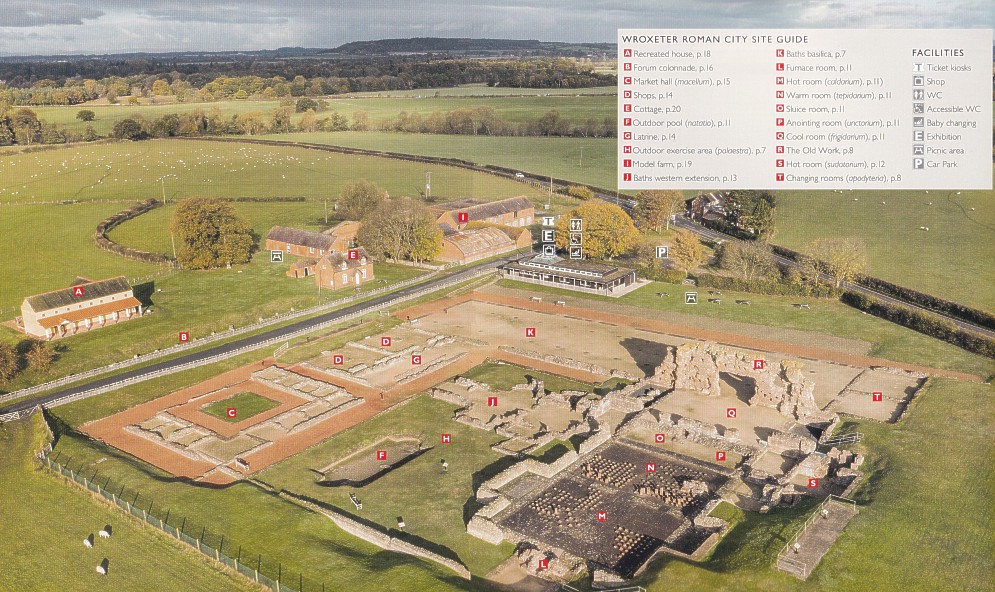
Aerial view of the excavated portion of Wroxeter Roman City looking directly north. The River Severn is out of view to the left. The reconstructed villa (A) sits in what would have been the forum whose entrance was marked by the colonnade (B). The small white dots in (M) and (N) are pillars that held up the floor of the bath area (L through Q), so the heat from the furnace (L) could circulate below. The museum is near the top, just to the left of the parking area.
When the Roman army arrived, they found the land occupied by the Cornovii, an Iron-Age tribe. Archaeologists think they had lived in the
area for more than 1,500 years. Their early settlement was probably a fort on a hill to the east called the Wrekin. It is believed that the
English name Wroxeter is derived from the hill's name.
To control access, the Romans built camps on both banks of the River Severn just to the west. A fort for 500 cavalrymen was
established around A.D. 47. Within 10 years, this grew to a fortress large enough for a legion of 5,500 men. This formed the heart of the
later city, which the Romans called Viriconium Cornoviorum or the city of the Cornovii by the Wrekin. The Cornovii would have had to
adjust to the Roman way of doing things, including using money instead of a bartering system and learning to speak Latin.
The fortress was designed to provide everything the legion required: living space for its troops and officers; workshops; stores; a
hospital; the headquarters building; a bath house; and a mansion for the commander.
The fortress lasted only about 40 years, but the street layout was maintained and extended to create a city four times larger than before.
To me, the most impressive of the ruins was the "Old Work" - completed in about A.D. 150. The bath complex had included a covered exercise
area, an outdoor swimming pool, and a series of rooms progressing from unheated to extremely hot. But the baths offered more than bathing.
Most had food stalls facing onto the street so both bathers and passers-by could see the products being sold. Behind the shops was a
public latrine.
Across from the bath complex was the forum, the political hub of the city. The remnants of a colonnade - a long row of columns - are all
that can be seen today, but the forum occupied about 2.5 acres and would have had shops, a large courtyard in the middle, and
administrative and judicial offices.
There would have been several villas near the forum that provided housing for more well-to-do residents. In 2010, it took builders six
months using traditional Roman tools and techniques to construct a replica villa at Wroxeter. TV Channel 4's series, "Rome Wasn't Built in
a Day," documented the work.
The thick walls of the villa meant when we arrived it was still cool inside from the previous night. It was there that we took temporary
refuge!
By the fifth century, the Roman Empire had collapsed and Wroxeter was abandoned. And, by 4 p.m., we were ready to collapse and abandon it
as well!
Today, Wroxeter Roman City is owned and managed by English Heritage, a charitable organization that operates more than 400 historic
monuments, buildings, and places in England.
Feeling a bit peckish, we headed off to Shrewsbury, which has a great American-style barbecue restaurant. Unfortunately, it was fully
booked, as it was Father's Day weekend. So, we drove on to The Highwayman in Oswestry and ordered typical British fare - Yorkshire pudding.
It wasn't Italian, but it was a great way to end our day.

(l-r): Baths area. Small pillars that held up the tile floor are everywhere; Gloria and Art in front of the "Old Work"; Art and Jan close out the day at The Highwayman. (large photo from the English Heritage site booklet)
Comments? [email protected].
Other columns from this year: Current year Index.
Links to previous years are on the home page: Home