Kansas Snapshots by Gloria Freeland - July 24, 2026
So when we were in Wales last month, it sounded like it would be fun visiting the places William and the rest of his Jones family called
home before he left for America.
"Fun" was the operative word, so on the selected day, we didn't even leave our holiday home in Llanrhaeadr until after 10:30 a.m. It was
perfect timing for a late lunch at Caffi Bont - "The Bridge Café" - a cozy little restaurant in the slate-mining village of Blaenau
Ffestiniog (bly-nye fess-TIN-yog). Our immediate goal - besides lunch - was to find the home where Anne Roberts' parents lived. Anne was
William's first wife and mother of his daughter Mary - so, Humphrey's half-sister.
We sought help at the police station. The friendly officer shared that she and her boyfriend plan to travel Route 66 through the American
Southwest next year to celebrate his 30th birthday.
But we were to be disappointed. The Roberts house wasn't in the computer file with all of the village's named buildings. Either the name
had been changed - rare, the house was demolished - very rare, or it never had a name and the census-taker had instead used the street
name.
This was not an auspicious start, but the day was just beginning.
Driving northwest, we crossed the historic Menai Bridge and onto the Isle of Anglesey - an epicenter for Druids and bards, or so we had
heard. Ninety minutes and 45 miles later, we stopped at a rural church. It was intriguing, as it was called the Llanfihangel Tre’r Beirdd -
"St. Michael's Church of the Bards." Bards were poets, singers, and storytellers of ancient Celtic societies.
The Joneses had been nonconformists, meaning they were not members of the Church of England. They were sometimes called Methodists and at
other times, Baptists. In the U.S., most of William's folks were practicing Presbyterians, though his second wife was a Quaker.
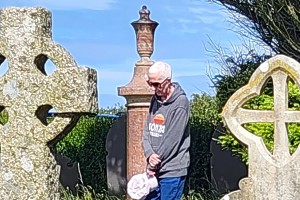
Wandering the "bards-church" cemetery
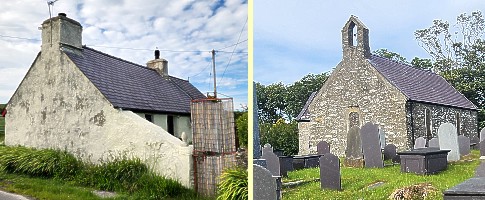
Upon marrying, William's parents attended the Hebron Congregation Chapel half a mile northwest of the bards' church. In the 1820s, people
walked to services and, for folks living to the north as his parents had, the chapel would have been more convenient. Today, it's an
ordinary home.
So why mention the bards' church? People wanted to practice their religion as they wished, but also wanted records of baptisms, marriages
and deaths. The little chapels couldn't provide the latter. But local Church of England vicars seemed quite tolerant of these folks. They
occasionally led services in nonconformist chapels and recorded milestone events in the official church records.
William's mother was Mary Thomas and his father was Humphrey Jones. We assume William named his son Humphrey to honor his own father. The
1829 baptismal record for William's older sister Jane indicated it took place in the Hebron chapel.
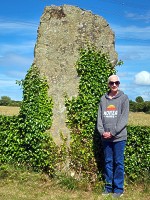
About 1,000 feet south of the bards' church in a roadside hedge was a "standing stone" perhaps nine feet tall. We would later see a much
taller one in a farmer's field.
These stones were erected during the late Neolithic and early Bronze Age - about 3500-1400 B.C. Little is known of the people who placed
them or for what purpose. It has been proposed they were used to judge astronomical events, for ceremonial purposes, or as directional
markers for ancient pathways or burial chambers.
Today, we frequently refer to their priests as Druids, but what we "know" is almost completely speculation.
Standing Stone south of the "bards-church"
We walked the cemetery surrounding the nearby medieval St. Mary's Church in Bodewryd - Ewryd's dwelling. Lightning struck the stone
building in 1867, and Lord Stanley of Alderley, a convert to Islam, funded the restoration on the condition that Islamic patterns be
incorporated into the stained glass windows. William's parents are buried in the churchyard, although we only found the father's
gravestone.
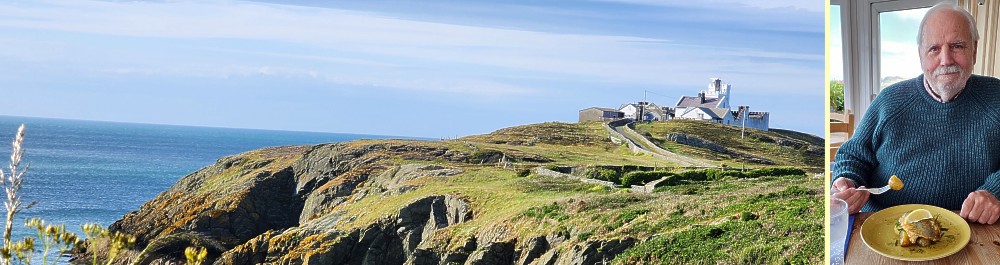
With our history adventures completed, we were ready for a break. Art drove along the coast, satisfying my desire to take in views of the
sea, Point Lynas Lighthouse, craggy shorelines, stunning cliffs, and wild flowers on nearby hills.
We passed through Amlwch (am-LOOCH), a historic port and the northernmost town in Wales, and then stopped at Bull Bay. We enjoyed watching
the passing ships and small boats through the large sea-side windows of The Cove Restaurant in the Trecastell Hotel. We both ordered
pan-fried sea bass with roasted new potatoes and samphire - a bright-green succulent seaweed sometimes called "sea asparagus" or "sea
beans." I enjoyed its crunchy texture and salty flavor - a new experience. The meal was a delicious reward for our "hard work" that day.
By 8 p.m., we were homeward bound. The clouds reached down to meet the mountains, providing a dramatic landscape - a fitting ending for our
12-hour excursion. We hadn't met any bards or Druids, but now the Joneses seem almost like family.