Kansas Snapshots by Gloria Freeland - July 3, 2026
Surprise "Fourth of July" story
Freeland Fourth-of-July celebrations have often been fodder for my columns over the years. We would gather, talk, enjoy a barbecue, light
a few fireworks of our own, and then finish the day gawking at the efforts of neighbors or of the town. So I was confident I'd find
inspiration for one in America's 250th birthday party.
But over the years, the ranks of our older family members have thinned and the younger ones are mostly scattered. The Grinch of
fire-protection insurance and the depletion of city budgets have eliminated once-common public fireworks displays. Since we just recently
returned from a trip overseas, husband Art and I were happy to just chill, making the prospect of a holiday-related offering this year
seem dim.
But Art came to the rescue, albeit unintentionally.
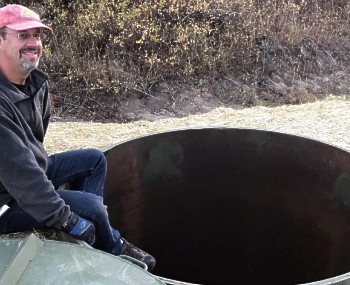
The attempt would be made in Colorado, but there is a Kansas connection. Eric Krug, the fellow in the hat, is from the Wichita area. The
article Art was reading was from the Loveland Reporter-Herald. Of Krug, it said:
His love of fireworks started young — he grew up in Kansas and his mother got tired of him setting off fireworks in the yard. She
called the local fireworks store and got him a job "so I wouldn’t burn up all her flowers." He eventually got his pyrotechnic license
and moved to Loveland in 1985, where he's been a part of the city's Fourth of July fireworks show for many years.
The firework was to be fired from the 26-foot-long steel tube buried in the top of a mountain. Krug was one of a four-member team. He
was quoted in the article as saying, "Basically anything that involves math, I do."
While involved in pyrotechnics since he was a kid, the driving force behind this project was team member Tim Borden, a Steamboat Springs
local who has his own licensed firework-making facility. He too has been involved in fireworks much of his life.
Of course, many people try to set a world record. It's the doing part that is tough.
Art had another surprise! The article was from 2020. Krug and the others not only attempted to set a world record, they actually did it.
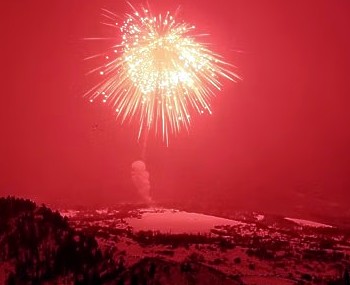
The 2,800-pound five-foot diameter firework was hurled close to a mile in the air. An attempt in 2019 had failed spectacularly, when the
firework never got off the ground. But this one had done the trick, and the people from Guinness World Records were there to certify it.
The record shot was not an Independence-Day event either, but happened at an annual winter festival. Still, this does seem like an
appropriate time to share the tale.
But Art's biggest surprise was yet to come.
"Eric is a former student of mine," he said, grinning. "And in a very small way, you are connected to this," he added.
Say what?
Record-setting firework (image: ksat.com)
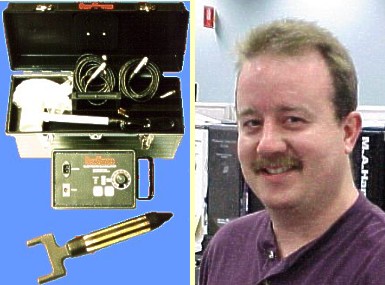
For some years, I've occasionally volunteered or been drafted to help Art with his work. One of the items he makes is a grain-dryer
temperature sensor sealed in a brass tube. In 1985, Art was teaching part time and working part time. Eric was with him when Art wondered
aloud what he should place the prototype sensors in. Eric suggested a brass tube, adding that Varney's Book Store in Aggieville had some.
Art liked the idea, and Eric hopped on his skateboard and headed out to buy a few. Forty-plus years later, that is still how Art makes
them.
Art said Eric once commented he should have asked for royalties.
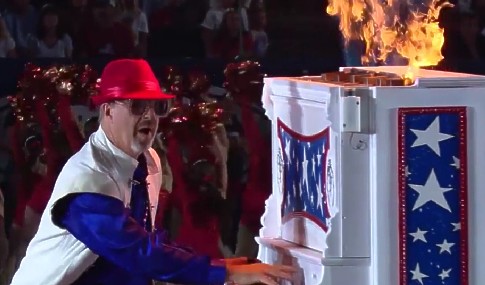
But there was more. In 1980, a Fourth of July celebration that has come to be called the "Stadium of Fire" began at Brigham Young University
in Provo, Utah. It's a sold-out 50,000-attendee affair.
Art has often shared a story from when Eric worked for HP. He had told Art that if he ever knew someone who was first rate and looking for
a job, they'd hire him. Several years later, a fellow who had worked for Art mentioned his dream of living and working in Colorado.