Kansas Snapshots by Gloria Freeland - June 19, 2026
Medical "miracles"
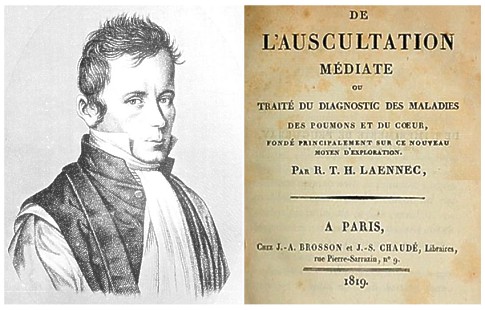
In 1816, French doctor René Laennec (lah-nek) faced a dilemma. He had a patient who appeared to be having cardiac problems. Common
practice involved placing his ear on the patient’s chest to listen to the heart sounds. The problem was the patient was a woman. Placing
his head against her bare bosom was, well, embarrassing.
So Laennec grabbed a nearby piece of paper, rolled it into a cone, and used it as an intermediary. He initially referred to his new
medical device as a "cylinder," then a "mediate auscultation" (ah-skuhl-tay-shun), but finally settled on stethoscope - from the Greek
words "stethos," meaning chest, and "skopein," meaning to explore. So the item that today more than any other identifies someone as a
medical professional was to treat that common medical condition called embarrassment.
René Laennec and title page from
his book on using the stethoscope
(image: researchgate.net)
I think most of us think of medicine as serious business, where solutions to potentially life-changing situations are pursued in a
deliberate science-driven matter. Yet the field seems to involve an unending number of tales where solutions such as the previous one
arose through circumstance as much as anything.
For example, in 1998, an article in the British Medical Journal began:
Fifty years ago this week, Philip Hench showed that "compound E" (cortisone) was capable of reversing the inflammation of rheumatoid arthritis. This discovery resulted from 19 years of imaginative and deductive observation together, perhaps, with that element of serendipity which seems to characterise many fundamental discoveries.
(No, I didn't misspell "characterize." That's how the Brits do it!) That "element of serendipity" involved noticing a woman's arthritis
abated when she developed another affliction. Hench presumed the two events were connected and the body was generating an inflammation
reliever.
His work paid dividends for me in 1997. I had a case of progressive paralysis created by my immune system attacking my own nerves.
Prednisone quieted the battle in my body by shutting down my immune system. Later, after being slowly weaned off the medication, my
immune system re-emerged not only no longer hostile to me, but actually more effective than it had been before. Hench's chance observation,
combined with years of work by him and others, led to prednisone. Without it, I would likely have been toast.
Another serendipitous situation came about during my 2022 tussle with breast cancer. The "mopping-up" radiation treatments after
surgery had long involved 20 doses of 2-Gray intensity. Once some method is shown to be effective, there is little pressure to change
because no doctor wants to mess with success or face an accusation of embarking on an untested regimen.
But a few years before I was diagnosed, mammography was coming into its own. Many breast cancers were being discovered that previously
would have been missed. This created a shortage of radiation-treatment situations, which prompted experimenting with increasing the strength
to 2.5 Gray and decreasing the number of doses to 16. If it worked, there would be 20 percent more treatment slots. It did work, and so, I
only received 16 doses.
Again I was a beneficiary during my recent breast cancer bout. In 1965, Dr. Barnett Rosenberg at Michigan State University was
investigating cell growth in the presence of electric fields. His experiment involved a mixture of metals, liquids and electricity.
This combo typically involves chemical reactions that could impact the results. So, using electrodes of the most inactive material was
desirable. Gold is the "gold standard" in this regard, but a bit costly. The next best option was platinum, although it did react some.
During the experiment, it was noted that the area near the electrodes was lethal to cell growth. The cause? The platinum! The very material
chosen to play no part led to carboplatin, one of the two chemotherapy drugs I and many cancer patients today are given.
This isn't to suggest that all medical advances are of a chance nature. In fact, many support Thomas Edison's famous quote, "Genius is one
percent inspiration, ninety-nine percent perspiration." For example, in 1955, the National Cancer Institute began looking for
naturally-occurring anti-cancer drugs. Quoting from the cancer.gov website site:
Between 1960 and 1981, researchers collected and tested an incredible 30,000 samples under this [NCI] program.
One ... proved to be pivotal ... In 1962, on an excursion in Washington State, USDA botanist Arthur Barclay collected bark and other
samples from the Pacific yew tree. Two years later, Monroe E. Wall ... and Mansukh Wani ... discovered that extracts from the Pacific
yew were toxic ... the most cytotoxic compound [was] ... called ... paclitaxel.
That led to the development of Taxotere, the other chemotherapy drug I was given.
While carboplatin and Taxotere are effective, they can have long-term serious quality-of-life side effects, some even being lethal.
While six every-three-week treatments have long been the go-to regimen, studies have shown that four cycles appear to be almost as
effective, but with far fewer side effects. That change may soon be coming to a cancer patient near you.
Last month, the results of a study led by University College London was announced. It involved more than 4,000 newly-diagnosed cancer
patients over the age of 40 in six countries. Patients took a test called Prosigna, which evaluated the 50 genes so-far identified that
appear to influence the growth of breast-cancer cells.
What was discovered was that for those who met certain criteria who would today be prescribed chemotherapy, about two-thirds experience no
long-term benefits. Stated another way, many can be spared the side effects of chemotherapy without harming their likelihood of enjoying a
future free of a spread of breast cancer.
The conclusion to these tales is that the next time you step into your doctor's office, your experience could be the result of hours of
mind-numbing research, serendipity, someone using statistical tools on thousands of records, or just some doctor trying to avoid
embarrassment. And for those of us who benefit from these medical "miracles," we’ll take them, whatever the source!
Comments? [email protected].
Other columns from this year: Current year Index.
Links to previous years are on the home page: Home