Kansas Snapshots by Gloria Freeland - May 29, 2026
It's so personal
When friend Joyce was here earlier in the month, one of the places I wanted to show her was the Marianna Kistler Beach Museum of Art on
the Kansas State University campus. The museum opened in fall 1996, long after we were students at K-State. The current exhibit
focuses on contemporary artists working in our state.
Although I sometimes find it difficult to relate to contemporary art, the works by Mona Cliff, Poppy DeltaDawn, and Ann Resnick "spoke" to
me.
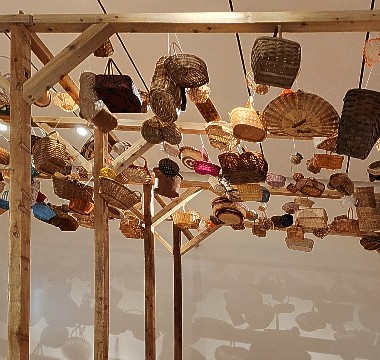
In the first gallery space, I was immediately drawn in by DeltaDawn's "Woven" exhibit. "Woven" - a tribute to basket-making - included
more than 300 baskets suspended from cedar beams. Some were made by the artist from Kansas-harvested juniper, while others were gathered
by her over the years. Others were family heirlooms.
The light filtering in created shadows across the floor and walls. It reminded me of the barn on our family farm, where light and dust
would sift down from the hayloft onto the stalls and settle onto the dirt floors. The exhibit was described as "part barn, part sky, part
memory chamber." It was all three for me.
DeltaDawn's "There is no Kansas" also caught my imagination. Made of ceramic tile and grout on panel, the work's message "... challenges
the notion of fixed borders and rightful ownership, pointing instead to deeper histories of displacement and care. A state, she suggests,
is not a state of being - but a passing system of power. What endures is more rooted than any name we give it."
Portion of "Woven" exhibit by Poppy DeltaDawn
That message definitely made me think a bit more about what we think we "own" in this life. I've always thought a better word for it is
"stewardship" - taking care of what we are given for our short time on earth so that future generations can enjoy it.
DeltaDawn is an assistant professor in the Department of Visual Art at the University of Kansas. Her current research includes the
communication and transition between ancient and modern technologies of labor as they relate to cloth production, land cultivation, and
lineages of knowledge.
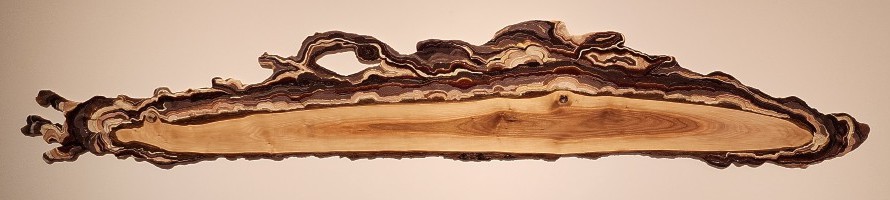
Cliff's "Conjured Topography"
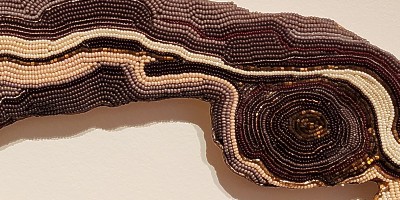
A close-up of the beadwork
Cliff's "Conjured Topography," a nine-foot-wide work made of seed beads, beeswax, thread, maple wood, plywood, resin and glue, looked like
a big fish from a distance. But as I drew closer, it reminded me of our rolling Flint Hills. I liked the description. "... Its sinuous
maple form, with its live edge, recalls a stretch of prairie land or a weather-worn ridge. But the intricate beadwork - thousands of
hand-placed seed beads shimmering in hues of plum, clay and bone - also rises like drifting clouds or gathering mist. ..."
Cliff describes her work on her website, monacliff.com:
My work primarily focuses on indigenous joy & resiliency of our ever evolving contemporary native culture. The foundational materials
of my work derive from the materials we use in ceremonies and social gatherings. ... My work explores generational knowledge, how
contemporary & traditional material are used to signify contemporary indigenous identity.
... To me the materials such as seed beads represent resiliency, because seed beads were used in trade during colonial conquest. I am
fascinated with how our native communities utilize seed beads in our personal expression of our specific tribal visual language. ...
Cliff, a multi-disciplinary visual artist and muralist, is a member of the Gros Ventre tribe (A'aninin/Nakota Nations) of Montana, but she
lives in Lawrence, Kansas. Some of her works are in the permanent collections of museums in Kansas City, Los Angeles and Topeka. She has
also shown at the National Museum of Women in the Arts in Washington, D.C.
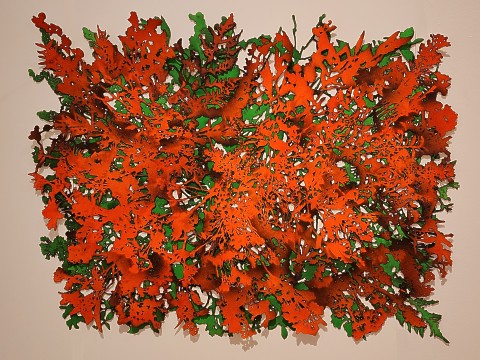
Resnick's "Cenotaph (Orange/Green)" was made of two layers of burned paper and spray paint. The vivid colors of the papers reminded me
of leaves and flames and the description helped me understand Resnick's work better: "A 'cenotaph' is a monument to someone whose body
lies elsewhere - an empty tomb, a gesture of remembrance. In this work, Resnick builds a memorial not from stone or inscription, but
from layered paper, its edges carefully burned by hand ... The act of burning - 'ashes to ashes' - introduces ritual into the process,
suggesting both destruction and reverence. In Resnick's hands, grief is not silenced or sealed away; it is made visible, luminous and
enduring. ..."
Although some in our society think we should "just get over it" when we lose someone we love, Resnick's work reminded me that grief is
a part of life and shouldn't be hidden away.
Resnick's "Cenotaph (Orange/Green)"
Resnick trained as a printmaker. She uses a broad range of materials and processes to produce large-scale, thought-provoking works.
She dedicates much of her time each year to activities that advance the arts as a whole.
For me, museum visits are often somewhat ephemeral - interesting while you're there, but then those feelings quickly fade after leaving.
But the works of these three artists stayed with me. They communicated their personal experiences, challenged societal norms, and told me
stories - all of which made me think about myself and home state of Kansas.
But I know others may visit this exhibit and see nothing more than old baskets, an odd "fish," and burned paper. When husband Art read my
first draft, he remarked that he liked my descriptions far more than the pictures.
Art is so personal.
Comments? [email protected].
Other columns from this year: Current year Index.
Links to previous years are on the home page: Home