Kansas Snapshots by Gloria Freeland - May 15, 2026
Flower Language
A week ago, I attended the monthly meeting of our Silver Creek Beneficiary Club at member Melinda's home. Our "theme" for the day was
flowers and for roll call, we were to give the name of our favorite flower.
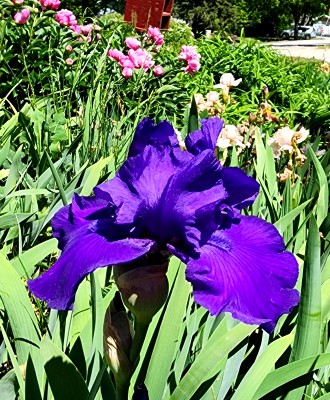
The day before, I had remarked to husband Art that our bright-pink peonies and purple, pink, mauve and yellow irises have been more
prolific than in recent years. Then it struck me! During the past four years we've been traveling in Europe in May. Maybe that played
a part in why the flowers seem especially vibrant and plentiful this year.
I really do like daffodils, peonies, and irises. Oh, and tulips and lilacs and day lilies and hollyhocks. I'm
also partial to sunflowers and other native flowers that brighten our prairies in the late spring and summer. There isn't much I can
think of that makes me smile the way a French field filled with poppies does. And my September birth flowers - asters and morning
glories - are pretty special too. I thought I had died and gone to heaven the year we visited the Keukenhof gardens in the Netherlands.
So it was indeed a tall order to name just one flower as a favorite. I somewhat playfully answered, "whatever flower is blooming
now."
We were to bring a houseplant, tell about it, and exchange it with another member. I took a cutting from a geranium with variegated
green-and-yellow leaves that I recently purchased from a local nursery. I chose it because it reminds me of my mother, who loved
geraniums and always had some in planters. I also like the scent of its leaves. Others shared cuttings from philodendrons, ivy, lambs'
ear, and so on. Some had come from plants that have been in their families for generations.
Mary brought a "surprise flower." It was a pop-up card in the shape of a basket of beautiful blue hydrangeas. I offered to take it home
as it will last for a long time on our dining-room hutch!
Joyce, our president, gave each of us a marigold seedling to plant. She told us marigolds symbolize joy, passion, creativity, and the
warmth of the sun, although they also hold significance in some cultures in mourning and remembering the dead. They are widely used in
festivals such as Día de los Muertos (Day of the Dead) in Latin America and the Hindu celebration of Diwali. In Christianity, they are
called "Mary's Gold," and were historically offered on the Virgin Mary's altar to symbolize devotion.
Before leaving, we took a tour of Melinda's beautifully-landscaped yard with a view of the green Flint Hills in the distance. She had
cut some dainty purple columbine, which she offered to me. It's a hardy native that attracts bees, butterflies, and birds.
Flowers have long played a part in our various celebrations throughout the year. May is certainly a month where flowers hold special
significance - May Day on May 1, Mother's Day on the second Sunday, and Memorial Day on the last Monday. Can anyone forget John
McCrae's "In Flanders Fields the poppies grow?" In 1945, our friend Bärbel was a World War II refugee. She told us how she would pick
wildflowers for the American soldiers who would then take them and give her a bar of chocolate.
Catherine Boeckmann of almanac.com, the website version of The Old Farmer's Almanac, wrote in February 2026 that the language of
flowers has been recognized for centuries. Shakespeare's works, as well as mythologies, folklore, sonnets, and plays of the ancient
Greeks, Romans, Egyptians, and Chinese have many references to flower and plant symbolism.
Boeckmann said learning the meanings of flowers became a popular pastime during the 1800s. Nearly all Victorian homes had, along with
Bibles, guidebooks for deciphering their "language." For example, during that era, bluebells were associated with kindness, peonies
with bashfulness, and tulips with passion.
Aloe: affection, also grief
Aster: love, daintiness
Baby’s breath: everlasting Love
Black-eyed Susan: justice
Carnation, red: deep love
Carnation, white: innocence, sweet love
Columbine, purple: resolution
Daffodil: unequaled love
Edelweiss: courage, devotion
Hollyhock: ambition
Iris: faith, trust, wisdom, hope, valor
Lilac: joy of youth
Lily-of-the-valley: sweetness
Morning glory: affection
Poppy: consolation
Rose, red: love
Rose, pink: happiness
Rose, white: innocence
Sunflower, dwarf: adoration
Tulip, yellow: sunshine in your smile
Zinnia: lasting affection
Boeckmann referenced a poem in "The Language of Flowers," published in London in 1875, that illustrates how flowers speak to us.
There is a language, little known,
Lovers claim it as their own.
Its symbols smile upon the land,
Wrought by nature’s wondrous hand;
And in their silent beauty speak,
Of life and joy, to those who seek
For Love Divine and sunny hours
In the language of the flowers.