Kansas Snapshots by Gloria Freeland - March 27, 2026
Cultural Quirks
Whenever we travel to new places, it's common to notice differences in the culture or in expressions that are used. For example,
our cars have trunks, while the ones in Britain have "boots." This even leads to something Brits have for which we have no direct
equivalent. Driving along the road, you might see a sign for a "Boot Sale." It references something akin to a flea market, but
most people only have the goods in the "boots" of their cars.
I was struck the first time I was in Europe that we could get a room without any proof we were willing or able to pay. If we saw a
sign for a bed-and-breakfast, we'd ask the owner to see the room and if he or she approved of our "looks" and we liked the space,
we agreed on the arrangement. Payment came the next morning.
If we wear a shirt referencing something or a place - Paris, Kansas State University, Phantom of the Opera - it typically refers
to a real thing. But in Europe, it may not. So one might see a shirt for the "New Orleans Bears" - a nonexistent team.
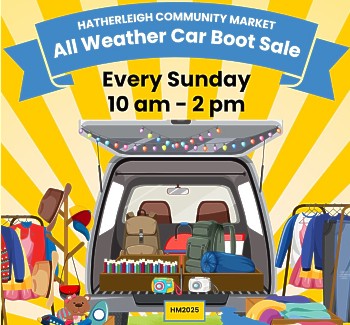
An "advert" for an every-week boot sale
Bumping into another person in a line in the United States is considered a no-no. But in a "queue" in Britain, well, it happens.
We have supper, but the Brits have "tea" - they may even have tea with their tea! After tea, you may be given a pudding, but
only occasionally is it truly a pudding because in England it describes what we call dessert.
Whether here or in Europe, when a person eats at a fast-food place, the customer pays before or when the food comes. But staff
at a sit-down restaurant would never ask a customer to pay until the meal was complete.
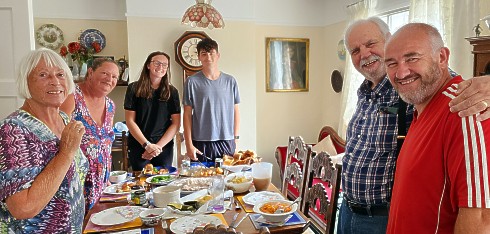
"Tea" at our friend Jan's place in England.
(l-r): Jan, daughter Leanne, grandkids Courtney
and Sam,
"brother" Art, and son-in-law Steve
However, in Europe it is considered rude to bring the bill until it is asked for, unless closing time is approaching.
If we decide to take in a movie, we pay before we enter the seating area, but if we buy a set of tires for our car, we would never
pay prior to their installation.
Cultural differences can be difficult for travelers to navigate. But when those travelers bring new ideas home with them, local
customs may change. When Art and I first started traveling to Europe in the late 1980s, fast-food "joints" were somewhat rare.
Now, many countries have McDonald's, Burger King and other franchises. Free coffee and soft-drink refills were once unknown in
Europe, but are becoming more common.
Changes can travel in the opposite direction as well. That international traveler named Covid-19 even schooled the Manhattan City
Commission to the fact that the sky wouldn't fall if restaurants offered street-side seating.
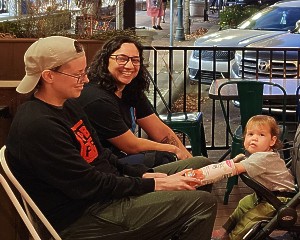
Daughter Mariya, wife Miriam and their daughter Diana
eat in a Manhattan streetside restaurant.
In Art's home state of Wisconsin, vehicles must have license plates on the front and back. In neighboring Michigan or here in Kansans,
one in back will do.
Necessity dictates some cultural differences. Streets in many old European towns are narrow, and parking a car frequently involves
one set - or even all the wheels - on the sidewalk. In the U.S., that usually buys the driver a ticket.
While many of these differences may lead to minor misunderstandings, others are more important. In the U.S., our car's insurance is,
in effect, applied to the car. So we can borrow that of another person and as long as we can legally drive and have the car owner's
permission to drive it, the car's insurance covers the vehicle.
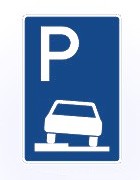
Parking sign indicating left-side wheels must be on walkway.
That's not the case in Britain, where the insurance is applied to the person. Most insurance covers only the driver while driving the
named insured car. Loaning your car to others, unless they have insurance that specifically states coverage for driving other vehicles,
will result in there being no coverage. It also warrants a ticket for driving without insurance. In fact, spouses cannot legally drive
their partners' cars unless listed on a policy as a named driver.
When two roads meet, we might see a "Yield" sign, but a Brit would see one saying "Give Way."
A street sign with a skidding car is not an unusual warning. But in New Zealand, it is frequently accompanied by one that says, "When Frosty."
When writing to a French man, there is always a space between the last word in a sentence and a question mark or exclamation mark, but
not the period. If I quote something, rather than " .... " Pierre prefers « .... ».
A sentence that is a question both begins and ends with a question mark when writing to someone in Spanish, but the one at the beginning
is oriented upside down.
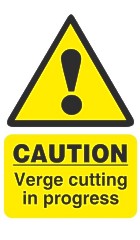
No worries, mate. They are cutting the shoulder grass.
Not long ago, a street name to our "German" kids would have been written Straße, but it has been decided that now Strasse is the modern
way.
Then there are differences that can be wickedly amusing. Here, being “pissed” means a person is angry. In Britain, it means they are drunk.
Homely is not a compliment here, but in Britain, it means "homey" or "comfy." The word "chuffed" is a slang word that in much of the
English-speaking world means pleased, but in the U.S., it can refer to that place where the sun never shines.