Kansas Snapshots by Gloria Freeland - February 27, 2026
Time warp
When husband Art returned from a recent meeting, I asked what had transpired. He said the most interesting part was when it was over.
Several people began chatting about how the days and weeks seem to fly by compared to when they were younger. One person suggested
the acceleration really took off after all their kids had left home.
That prompted Art to think about the seemingly-countless days he spent trout fishing with his dad. Those trips began when Art was 9,
and, until he turned 19, there were more than 20 every year. Once he began college, the necessity of spending summer breaks earning
money meant the number of those trips fell to half or less, then dropped to just a handful each year after 1971 when he moved to
Kansas. But whenever he thinks of those times, he is only occasionally aware of the fact that most of them took place while he was
still a kid.
This sort of telescoping of time hardly qualifies as news. It seems almost every adult I've ever known has at some point offered a
similar assessment. Childhood stretches out almost endlessly, while adulthood passes in a flash.
There are three popular explanations as to why our perception of time passage is so skewed:
1. The relative effect - When you are 10, one year represents 10 percent of your total life, but at 50, it is only two percent.
So each additional day feels like a smaller part of the total.
2. The "old brain" effect - Our physical brain operates more slowly as we age. This makes evenly-spaced events seem to arrive sooner
and sooner.
3. The uniqueness hypothesis - If a person’s day is filled with unexpected events, the day "feels" fuller and longer. As we age, more
and more of our daily events have been experienced before, and so, fewer grab our attention. Plus, we tend to fall into routines that
don't offer new and exciting "adventures."
A study published July 10, 2024 deals with the idea that time seems to speed up as we age. Psychology professor Ruth Ogden's research
team from Liverpool, England's John Moores University queried 1,000 Brits about Christmas and 600 Iranians about Ramadan. Their
question: Do you "feel like Christmas (or Ramadan) comes around more quickly each year?" About 75 percent responded yes, with the
percentages almost identical in both countries. Furthermore, older people were more likely to agree with the statement than younger
ones. So her work does support the notion that time feels as if it passes more quickly as we age.
But the three "reasons" above given for time acceleration are universally experienced, so why did 25 percent answer no?
Art suggested we may be dealing with what he calls the newborn-baby effect. Those people who are overtly "oooing" and "aaahing" over
a recent arrival are also likely to comment on its beauty. But those thinking, "Wow, that's an ugly kid" are unlikely to say
anything. So Art responded to the comments after the meeting because he was having the same thoughts.
Art had two uncles who were pilots in World War II. One mentioned how the time over the target seemed to last forever, but Art never
heard the other make such a remark. When he asked, the other said it went by in a flash! The difference? One flew in Europe at high
altitudes where the bombsight held the plane on a straight-and-level course. The only thing for the pilot to do was to worry if the
next anti-aircraft shell had their plane's number on it, and so those periods seemed to last forever. In contrast, the other flew over
Japan at low altitudes, where the air currents from the burning buildings kept the pilot busy just keeping the plane in position. His
time was filled and so, the time flew by.
We all have a number of internal clocks we might use to measure time. Most of us have a natural waking/sleep cycle that approximates
24 hours. The number of times our hearts beat or the number of breaths we take are fairly regular. But if we attempt to use these the
way we do a ruler to measure distance, we have difficulty devoting attention to the event being measured.
So, instead, most of us measure time by the occurrence of events. This can lead to paradoxical results. A weekend family reunion
without the opportunity to spend the desired time with each member may feel like time is flying by, yet the time from Friday to
Monday can seem very long.
Many things we think are simple, are really not. After all, it was once “obvious” the earth was flat. While time is one of the most
important elements in our lives, our innate ability to measure it is pretty poor - almost as poor as our understanding of how we do
it.
Right now, time seems to be dragging for me. The routine of having a chemotherapy treatment, followed by weekly lab visits, days of
side effects, and then eventually a few days where I feel almost-normal started in December and will extend through April and beyond.
Still, the days are flying by for daughter Mariya and her wife Miriam, who both work and are raising a 19-month-old daughter. Every
day is an adventure for them, as they watch their little girl running, jumping, talking, and learning new things.
These paradoxical perceptions of time can make a person appreciate the time warp rooted in physics and popular in science fiction -
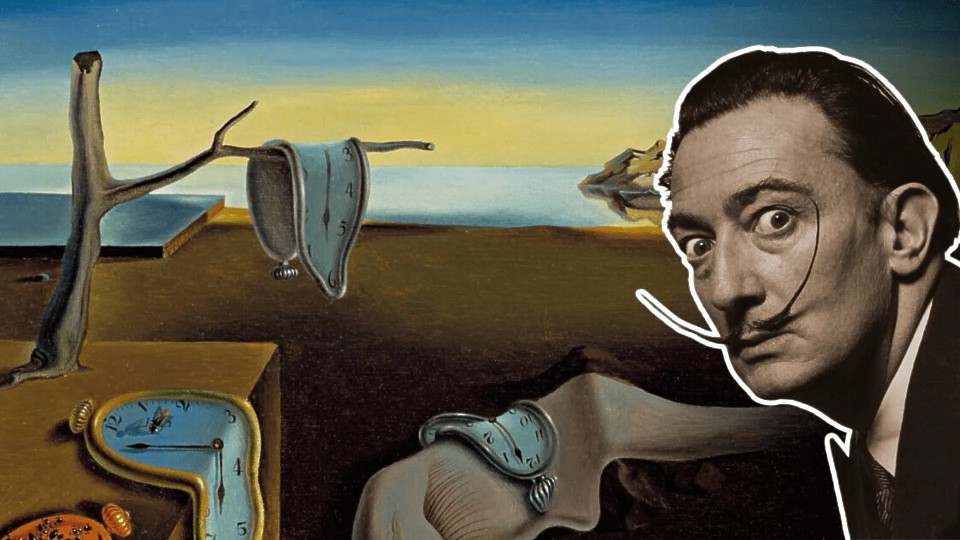
particularly in "Star Trek" and other sci-fi shows. Perhaps artist Salvador Dalí's "melting clocks" are more reflective of our
subjective reality, while the precision device we wear on our wrist measures our objective world.
I guess we have to make peace with the fact that not everything is simple.