Kansas Snapshots by Gloria Freeland - February 6, 2026
"The Wreck"
I probably should have written this two years ago for there is something appealing about round numbers. A 50th anniversary sounds
important. 48th? Not so much. Of course, there are some exceptions. Most people think their 21st birthday is a much bigger deal than
their 20th.
So why am I thinking about an event that happened on a very "un-round" almost 62 years ago? Two reasons.
The first has to do with what happened a couple of weeks ago. Husband Art and I were traveling west on Poyntz Avenue in Manhattan,
heading home, when seemingly out of nowhere, the fellow in the lane to our left decided he wanted to exit on the right. And he did,
requiring Art to brake to keep from plowing into the passenger door of his vehicle.
I started to wonder if we had a target on us when on the west side of Manhattan, a different driver pulled out of a side street,
crossed over the empty right lane, and pulled in front of us in the left, again requiring a rapid deceleration to avoid what is so
indelicately called "rear-ending" him!
Close calls involving a vehicle always make me think of "The Wreck."
The second reason I have been thinking about it a lot lately is because Art has been quizzing me, as well as my siblings and anyone
else he feels might be able to recall details. He even found two people none of us have been "close to" in, well, 62 years!
I wrote about "The Wreck" in my July 13, 2012 column. It happened 23 years before I met Art, so
while he had heard references to it, it sort of went in one ear and out the other. But something came up again recently and he
decided it was time to nail the details down while there were still some of us around to do the hammering.
And who were those two "close-to" people? They were the passengers in the other car that had come far closer than any of us
wanted to be!
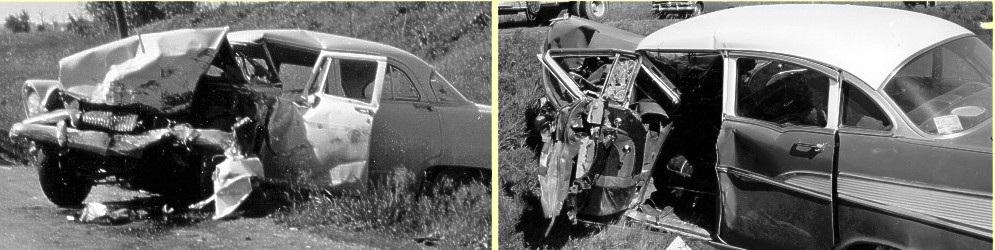
The short version of the story is my mom, siblings Dave and Gaila, and I were traveling north on U.S. highway 77 on the morning
of May 16, 1964. Dave, 16, was driving, when a car coming toward us crossed the center line. The left half of each vehicle met
and both came to a grinding halt almost immediately.
I still think it is a miracle we all survived. Gaila, 9, had whiplash and I, 10, had a separated clavicle, but they were minor
injuries compared to those of the other four. Dave had a broken left leg and deep gashes across his forehead and chest. The
passenger in the other car was thrown out and was unconscious for awhile. The other driver spent months in a body cast and had
two inches removed from his right leg so it would match his other leg, which was left shorter by the collision-generated damage.
Mom, 40, had a concussion and was unconscious for days. At the time, we siblings thought she was dead or dying.
Dad, who was at home on the farm, was taken to the scene by a neighbor. He said his initial reaction when he saw the cars was that
his entire family had been wiped out.
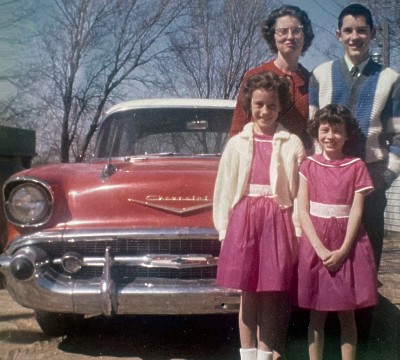
Photo taken the previous fall
Every year, about 40,000 people die in automobile accidents in the U.S. When the sum is calculated over an average lifetime, a
person's chance of dying in a car accident is about 1 in 100. Auto accidents overshadow all other causes of accidental deaths except
falls, and this latter group is largely populated by people experiencing the infirmities of old age.
It's hard to find any figures on the psychological impact of traumatic events. Art and I have done a lot of stories over the years
involving World War II. It was years after he left teaching that Art discovered his university department head had been a B-17 pilot.
John was what most people might call "manly" - 6' 6" and played basketball well into his 60s. Yet when Art asked about his service,
the first thing John mentioned as his eyes filled with tears was that one of his crew members was killed - a reaction to a trauma
long past. We found many soldiers deal with these things by refusing to talk about their experiences, even when their service was
many decades earlier.
Art's father’s entire work life involved trucking. Even though he and his dad were close, it was his mother who mentioned that when
Tom was 21, he had killed a postman. The mailman pulled out directly in front of the truck his dad was driving, which was
fully loaded with sugar. The inquest determined the accident was unavoidable, yet Tom didn't mention it.
After our wreck, Gaila didn't want to get into a car. For some reason, I was terrified that we were going to be hit by a train any
time we crossed railroad tracks. When we were older, neither of us wanted to get our drivers' licenses. To this day, I don't like to
drive.
Dad was always a good eater, so I was surprised to read in the letter he wrote to family after the accident that for weeks he found
it hard to eat.
When Art contacted the passenger in the other car, she mentioned how both cars had been "crowding" the center line and how today
she drives near the right edge of the road and wonders if that is a legacy of the accident.
When Art reached out to the other driver, the response came not from him, but from his wife. She commented that he never likes to
talk about it.
We all survived the physical consequences of the wreck with just a few scars. But the psychological impact? They may have
persisted more than we realize.
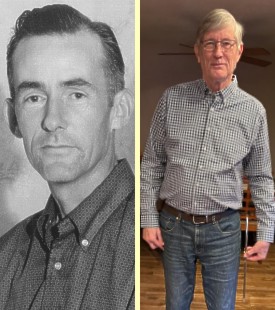
Dad, left, thought his entire family was gone.
David, right, holds the pin from his leg.