Kansas Snapshots by Gloria Freeland - January 16, 2026
It's Deb's fault
It was a beautiful September day in the Nicolet National Forest of northern Wisconsin. Having been a cool year, there was still an
abundant supply of blackberries. As husband Art picked, he was alert, aware that the slight breeze through the evergreen boughs
might cover the sound of another berry lover - one of Wisconsin’s many black bears that call the area home.
So he jumped when he heard a solid "thump" maybe 75 feet behind him. It didn’t sound like the footfall of a bear, yet it invited
attention, and he watched for a minute or more. But nothing appeared from the nearby wood and other than the breeze in the pines,
everything was again quiet.
"Thump!"
He turned again, but saw nothing. He yelled. Bears don't want a surprise meeting with a man any more than a man with a berry can
wants to meet a bear.
But, again, nothing.
Then, "Thump!"
This time he quit picking and watched and waited ... and then laughed.
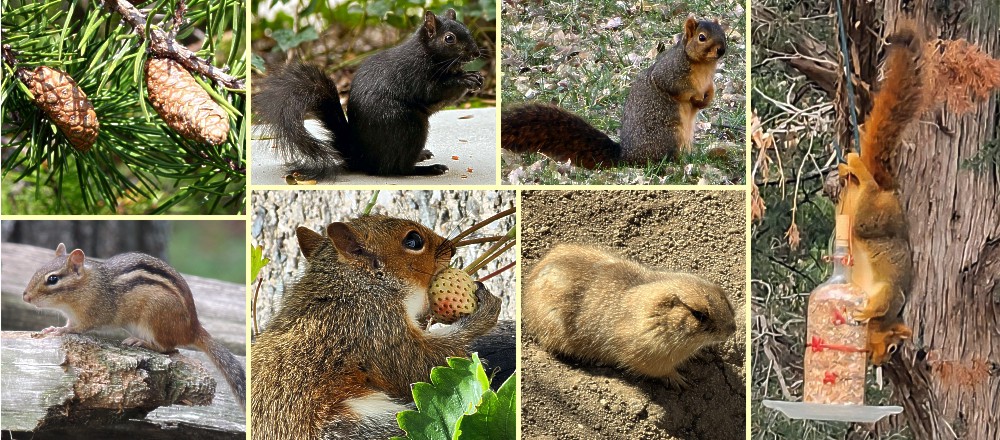
Near the top of a nearby pine, a red squirrel nibbled off a plump heavy-with-moisture green pine cone. A moment later, it struck the
ground with a convincing and familiar "thump" - imagine a two-inch-long pickle falling from 70 feet! He then zipped down the tree and
made off with it.
Art had just witnessed what The Global Tree Initiative site said about squirrels - that they help sustain the health of our
environment by acting as seed scatterers. Scientists have estimated that the critters forget 60-80 percent of seeds and nuts they
bury, which means plants grow where they left them. Acorns and pine cones are too large for birds or insects to disperse effectively,
but squirrels transport them to various locations around their habitats.
According to the ITIS.gov website (Integrated Taxonomic Information System), there are more than 200 squirrel species globally. They
range in size from the African pygmy at four- to five inches in length, to the Bhutan giant flying squirrel at more than four feet.
They typically have slender bodies with bushy tails and large eyes and their fur is soft and silky. Their tails are used to keep
rain and wind off their bodies, to cool them off by pumping blood through them, as a counterbalance when jumping in trees, and to
signal with. When one of them sits upright, its tail folded up its back makes it look larger from behind, deterring predators.
ITIS classifies North American squirrels into three types: tree squirrels, ground squirrels, and flying squirrels.
Tree squirrels, such as the ones that startled Art, make their homes in trees, but they also find nesting material and food on the
ground. They’re at home out in the country, where we live, as well as in urban environments, such as parks and even university
campuses, where I’ve often spent hours observing them.
Ground squirrels, such as chipmunks, marmots and prairie dogs, can be found throughout North America. Their only protection from
predators is to flee - or to startle them with chit-chit-chit or barking sounds. I had no idea the huge marmots we saw in the
snow-covered Rockies and the Alps or the prairie dogs that inhabit our state - and our local Sunset Zoo - were considered part of
the squirrel family.
Flying squirrels have flaps of skin between their legs. They can glide great distances giving the impression they can fly.
The coat color of squirrels is variable between - and sometimes within - species. In Kansas, reddish-brown fox squirrels are the most
common, but we also have gray squirrels with white underbellies.
Marysville, Kansas, population 3,500, has a large number of black squirrels. There are other cities and villages with these
concentrations and it seems everyone has a "story" to explain their presence. Marysville's involves a 1912 carnival passing through
that had a cage of black squirrels as a sideshow attraction. A young boy released the caged critters into a park, where they
flourished and quickly grew in numbers. This darker squirrel ended up becoming the mascot of Marysville in 1972.
It's a nice story, but in reality, these dark squirrels are just a genetic variation of the common gray squirrel. Other such cities
with black squirrel concentrations include Council Bluffs, Iowa; Hobbs, New Mexico; Kent, Ohio; London, Ontario and so on.
So what prompted all this squirrel business? I'm going to blame my friend Deb. She recently sent me a picture of one in her back
yard, captioned, "I have a very acrobatic squirrel raiding the bird feeder." The photo made me laugh. The squirrel was hanging upside
down, its tail in the air, and its front paws wrapped around the feeder.
But there is also a bit of an inside joke at play here. At some point in the past whenever Deb or I got off topic, the other would
yell, "Squirrel!" Then we’d both laugh uncontrollably. We did it so often that I even bought a squirrel charm for the bracelet I
purchased for her to remind her of our sometimes-disjointed conversations.
Some people go down rabbit holes; we chase squirrels. This is a perfect example. Deb mentions a squirrel, and soon I'm doing
research for a potential column on, what else, squirrels!
Oh, and if you are a fan of our furry friends, you can celebrate them next Wednesday as it's National Squirrel Appreciation Day!