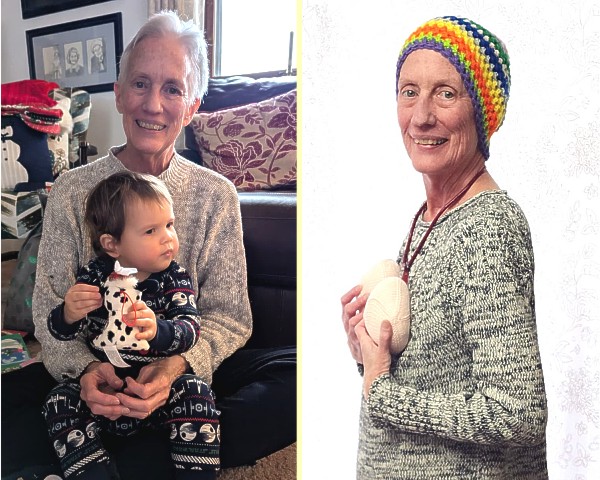
Left: Gloria and Diana shortly before Gloria's trim. Right: Gloria and her "Knitted Knockers"
Comments? [email protected].
Other columns from this year: Current year Index.
Links to previous years are on the home page: Home
Kansas Snapshots by Gloria Freeland - January 9, 2026
What is "normal?"
Where I grew up, people didn't eat raw eggs or raw hamburger. So when European friend Francis orders his steak tartare - a common
dish in France - it feels wrong.
Husband Art said when he was young, Santa Claus was the only man he knew who wore a beard. While a few men, such as movie star Clark
Gable, had pencil-thin mustaches, most opted for the clean-shaven look. Even today, when Art sees a man with two days of stubble, he
thinks the fellow didn't have time to finish his daily grooming.
These are examples of how things that are usual or typical become what is considered right or proper. Often those that are different
are labeled as wrong.
When I look out over the wide vistas of my native state, I feel contentment. But Art's mom Donna grew up in Wisconsin's land of trees
and lakes, so she sometimes referred to my home state as "that Godforsaken place."
I've been wrestling with some of these learned standards myself recently. My chemotherapy treatments caused some of my hair to fall
out, so I asked daughter-in-law Miriam to shave my head. While I was mildly startled after to discover how quickly my head grew cold,
a much bigger surprise awaited. I often have received compliments on my hair. While others struggle with locks that slowly shift from
youthful colors to various shades of gray and yellow, mine changed fairly quickly from brunette to white. With a short cut, I was good
to go.
Miriam did exactly as I requested, but when I looked in the mirror after her barbering efforts, pictures of women in concentration
camps came to mind. I'm not expecting compliments any time soon.
Our brains are masters at recognizing patterns which we then internalize to tell us what is "normal." But even Art changed his
opinion about men with facial hair as he's had a full beard and mustache for years.
Men have long been seen with or without hair on their heads, so either condition is entirely acceptable. But baldness in women seems
wrong because it is so unusual.
Hair hasn't been the only item for me to ponder. Females of all mammals suckle their young, but humans are the only ones with
continually prominent breasts. When I was young, I had a love-hate relationship with mine. Sometimes they attracted attention that
was unwanted, yet I felt they affirmed I was a woman.
As one measure of the importance American women place on the size and shape of their breasts, approximately five percent of them
have ponied up an average of $10,000 to have them modified. One can only guess what those numbers would be if everyone who wanted the
cosmetic surgery could afford the price tag.
More evidence can be found in the fact that of women who have a mastectomy, between 30 and 50 percent also have reconstructive
surgery, despite the fact that the "breasts" fashioned from the flesh taken from their bellies, backs, butts, and thighs create new
scars and serve no biological function.
Last October after having my double mastectomy, I was leaving my surgeon's office when Sam, his nurse, gave me a small bag that
contained two knitted balls of yarn made by the "Knitted Knockers" organization. While I appreciated the concern over my
psychological well-being, it was also a sign that women are under so much pressure to look "normal" that they will don unneeded bras
and fill their cups with unneeded and nonfunctional breasts made of yarn.
A number of years ago, Art and I attended a drag show at McCain Auditorium and were intrigued by one of the performers. Dressed and
made up as attractively as any woman I've met, she slowly removed "her" makeup and related clothing. Before our eyes, "she" slowly
become "he." He ended by asking, "What is a woman and what is a man?"
In 2013, movie star Angelina Jolie was told she carried the gene mutations that make the likelihood of her getting breast and ovarian
cancer almost a certainty. She chose to remove the related organs in an attempt to thwart death - one her mother didn't escape. Now
that she no longer possesses the breasts and other organs we routinely associate with being a woman, should she be considered less of
a woman?
In contrast, after my treatments are over and my hair grows back, will I then be more of a woman?
The philosopher Socrates was famous for illustrating a point by telling a story. In one, he meets an admirer who tells him how much
he reveres the philosopher. Socrates then asks if he would admire him less if he were old and gray, if he were ill, if he could no
longer speak, and so on. In each case, the admirer says he wouldn't think less of him. Socrates then notes that the man claims his
admiration is undimmed, despite Socrates casting aside everything that makes him who he is. He then asks just what it is the man
admires.
Biologists say a woman would have been relegated to the scrap heap after her reproductive years passed unless she was contributing
to the survival of the species in some other way. If they are right, then the reproductive role is just one stage of a woman's life.
When it passes, she loses the ability to have children, possibly losing some of her then-unneeded hardware as well. She then moves on
to delivering what those biologists call the "grandmother effect," whether it be as an actual grandmother, as a teacher, or in some
other way contributing to her community.
I enjoyed my girl/youngster stage as I loved my becoming-a-mother years. Now I'm relishing this new phase with granddaughter Diana,
and she seems to be enjoying her GG - Grandma Gloria - too.
Left: Gloria and Diana shortly before Gloria's trim. Right: Gloria and her "Knitted Knockers"
Comments? [email protected].
Other columns from this year: Current year Index.
Links to previous years are on the home page: Home