Kansas Snapshots by Gloria Freeland - January 2, 2026
"Useful, with a pleasant degree of humor"
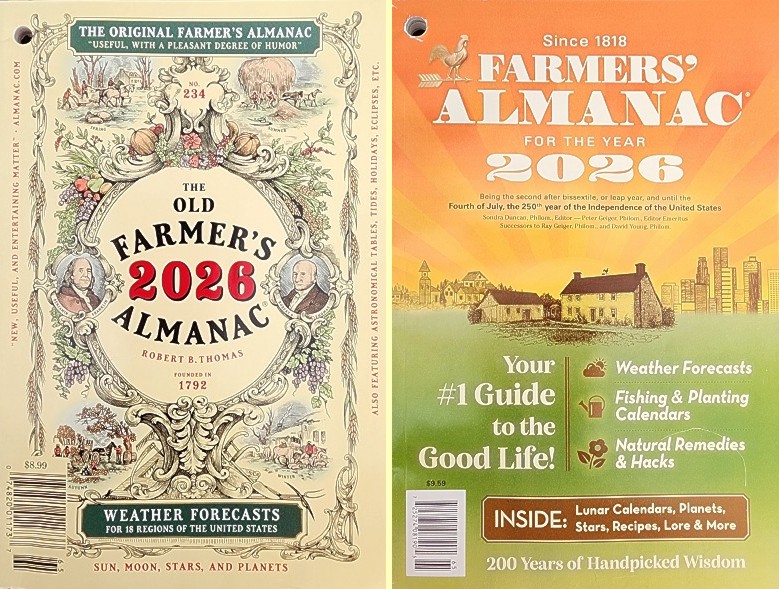
When I heard Farmers' Almanac would discontinue publication after the 2026 edition, I immediately grabbed a copy and one of The Old
Farmer's Almanac from a local drugstore. I was somewhat familiar with the latter, since I had purchased it for dad for a number of
years as a Christmas present. I hadn't really paid much attention to the former. I thought it would be fun to learn more about them,
so I sat down to skim through them over the Christmas-to-New-Year's holiday.
So what is an almanac and how have they changed over time?
I checked several sources, but I preferred the description I found at britannica.com. It said an almanac contains:
a calendar of the days, weeks, and months of the year; a record of various astronomical phenomena, often with climate information
and seasonal suggestions for farmers; and miscellaneous other data. An almanac provides data on the rising and setting times of the
Sun and Moon, the phases of the Moon, the positions of the planets, schedules of high and low tides, and a register of ecclesiastical
festivals and saints’ days. The term almanac is of uncertain medieval Arabic origin; in modern Arabic, al-manākh is the word for
climate.
The first printed almanac appeared in Europe in 1457, but they have existed in some form since the beginnings of astronomy. Ancient
Egyptian and Greek calendars showed festival dates and days thought to be lucky or unlucky, while Roman versions were later made into
lists resembling modern almanacs.
Almanacs began to gain real prominence after the development of printing, and early ones gave as much space to astrology and
predictions of the future as they did to calendar and astronomical data. As new scientific knowledge was gained in the 17th and 18th
centuries, the more sensational elements gradually disappeared from their pages.
In both Europe and colonial North America, the almanac contained proverbs, medical remedies, jokes, poems, and fiction. Guided by the
almanac, farmers were able to estimate the proper time to begin seasonal farm work.
The first almanac printed in colonial North America was An Almanac for New England for the Year 1639, compiled by William Pierce and
printed in Cambridge, Massachusetts. Benjamin Franklin began his Poor Richard's Almanack, the most famous of American almanacs, in
Philadelphia in 1732. Franklin borrowed the name "Richard" from Richard Saunders, the 17th-century author of a popular London almanac
called Rider's British Merlin.
In the spaces that occurred between noted calendar days, Franklin included proverbs about industry and frugality. He said he found
most of them in books, but he shortened and sharpened them. A couple of his most-famous ones are: "Early to bed and early to rise,
makes a man healthy, wealthy, and wise" and "Time is money."
Poor Richard's was a best-seller in the American colonies until Franklin sold it in 1758. At the height of its success, about 10,000
copies were printed annually, a large circulation for that time.
There are several types of modern-day almanacs. The best-known contain a collection of statistical, historical, and other
information. Examples are The World Almanac and Book of Facts, first published in 1868. The Old Farmer's Almanac is of a more
traditional style and has been continuously published in the United States since 1792.
Both the Old Farmer's Almanac, a New Hampshire-based publication, and the Farmers' Almanac, first published in 1818 and based in
Maine, have included information about planetary positions, lunar cycles, and long-range weather forecasts, as well as gardening
tips, trivia, jokes, and natural remedies.
Throughout the 20th century, both almanacs thrived, giving farmers and gardeners information they couldn't get anywhere else. More
recently, the publications’ editors turned to websites, social media platforms, specialty publications, and even public-television
programs to give readers a number of ways to access their information.
Farmers' Almanac editor Sandi Duncan said her publication's closure was caused by "financial challenges connected with producing and
distributing the almanac in today's media environment." The company listed its circulation as 510,000 copies, numbers far behind
those of The Old Farmer's Almanac, whose circulation is 2.5 million.
I'm glad The Old Farmer's Almanac will still be around. It reminds me of my dad, a farmer who often found its advice useful and its
other information entertaining.
As I perused its pages recently, I found all sorts of interesting tidbits - an article about how agritourism - pumpkin patches, corn
mazes, Christmas tree farms, trail riding, event barns for weddings, and more - is helping farmers diversify; recipes for
tomato-bacon jam, tomato turkey burgers, and tomato-basil ice cream (not sure about that one!); factoids about the planets in our
solar system (Uranus has 28 moons, all named for characters in works by William Shakespeare and Alexander Pope); and an article on
the history of leftovers. ("Flatbread estimated to be around 70,000 years old claims the title of the world's oldest leftover. The
remnants were discovered in a cave about 500 miles north of Baghdad, Iraq.")
At 256 pages, it will keep me occupied for a good share of the winter. And, come spring, perhaps it will inspire me to add to my
native garden!
Executive digital editor Catherine Boeckmann recently said, "... We estimate that The Old Farmer's Almanac has survived and thrived
all these years because we have maintained Robert B. Thomas's mission: "to be useful with a pleasant degree of humor. ..."
It seems to me they've succeeded!