Kansas Snapshots by Gloria Freeland - November 28, 2025
Awed by all of it
"Wow, that's awesome!" Katie exclaimed. "Dang! That's pretty! Oh, wow! This is the first time I've ever seen them!"
I had to smile.
Husband Art and I had phoned daughter Katie at about 8:30 p.m. We were interrupted by a text from her husband Matt, who was returning
from a meeting, saying she should go outside. Her reaction stepping into their back yard was familiar.
There had been some discussion on news and weather reports that we might see the Northern Lights that night. With Katie and Matt
living so much farther north and being closer to the earth's magnetic north pole, I figured they would have a much better chance of
seeing them than we would. But when I first asked, she responded, "Too much light pollution in Madison [Wisconsin] to see much of
anything, unfortunately."
Then Matt texted!
That's the way the Northern Lights are - nothing at all one minute, and then they begin to shimmer and glow.
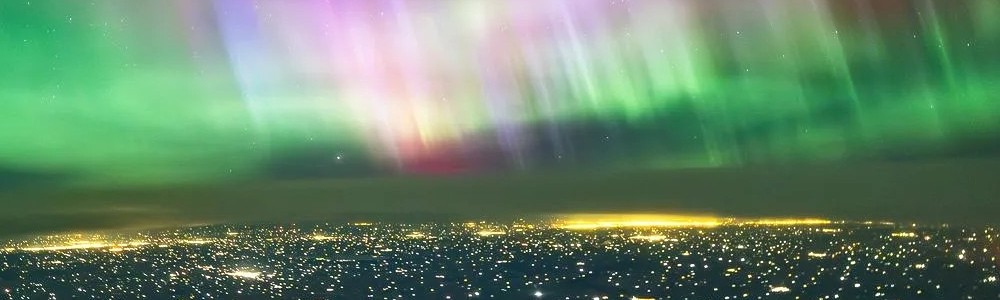
Pilot Matt Melnyk took this picture from his Boeing 787 Dreamliner at 36,000 feet over northeastern Alberta on a recent flight from London to Calgary. Melnyk, "a seasoned aurora chaser," said he sees auroras 90 percent of the time on his flights across Europe. "... It's rare to be flying at the exact time a major solar storm is happening, so I consider myself extremely lucky to be able to witness this event."
Since Art grew up in Wisconsin, he didn't think of them as particularly unusual. So when I mentioned a few years ago that I had
never seen them, he found it hard to believe.
They are created by a burst of particles ejected from the sun interacting with the earth's atmosphere. This activity occurs in an
11-year cycle and we are near a peak right now. Cool-to-cold nights cause the atmosphere to be more dense and so the collisions are
more abrupt, making the display more intense.
Standing outside on cold nights is not something I typically consider, but I braved one in May 2024 when we were in Wales because I
knew there was a possibility of seeing them. Like Katie, I was richly rewarded. I was enchanted by the vertical purple-yellow-green
"curtains" that danced across the night sky. We saw them again in Kansas in October that same year.
We chatted with Katie a few more minutes and then went outside to our front steps. A large red "cloud" hung over the nearby hill
and a green one was above the house across the street.
We jumped into our van and headed north on winding, rutted, and dusty Kitten Creek Road. Art had only bothered to partially dress
and I was wearing a top with sweat pants and slippers, but we doubted the sky would mind.
We parked at the crest of a hill, and Art turned off the lights. A pickup was parked just to the west on the cross street. After
about 20 minutes, the pickup turned around and left. We stayed an additional half hour, but the show was over.
It turned out our "pickup partner" had been our neighbor Jim! He had been out a couple of hours before us, and the pictures he
captured were stunning! Friend Pat had been at the Top of the World hill just northwest of Manhattan and she also took some great
photos.
People have been awed by the Northern Lights for thousands of years. Illustrations of the phenomenon were found in a cave in
southwestern France, where 30,000-year-old finger tracings show the twisting lights. In 567 B.C., an astronomer working for Babylon's
King Nebuchadnezzar II inscribed his report on a stone tablet. In 1619, Galileo coined the term "Aurora Borealis" after Aurora -
the Roman goddess of dawn - and Boreas - the Greek god of the north wind.
A 2023 Popular Mechanics article explained the science:
The cause of the Northern Lights begins 94 million miles away ... a solar eruption that ejects billions of tons of superheated
plasma into space ...
When those solar particles smack into the Earth's magnetic field, they are accelerated up and down our planet's magnetic field lines
toward the North and South [magnetic] Poles. Along the way, they collide with atoms of nitrogen and oxygen in the atmosphere,
infusing those atoms with a surplus of energy that is then released in a burst of lights.
Solar particle interactions with oxygen produce red or green, while those with nitrogen produce green or purple. The magnetic force
lines affect the pattern, creating the ripples, curtains, and streaks.
With the sun's ejections being near a peak right now, the Northern Lights have been seen as far south as Mexico. But northern states
typically see more than we do.
The Aurora Borealis, as well as its southern counterpart - the Aurora Australis, is visible most nights of most years in the Aurora
Zone - the area that lies within 1,500 miles of the poles. In the north, that includes Greenland, Russia, Sweden, Canada, and others.
Una Gísladóttir, a former pilot, said a number of legends are associated with the Northern Lights. In Estonia, people believe they
are the tracks of horse-drawn carriages making their way to a wedding ceremony. In Finland, some consider them to be the artwork of
a celestial fox painting the sky with its bushy tail. Her favorite is from her native Iceland where the Northern Lights are thought
to be the spirits of departed loved ones dancing in heaven.
In Sweden, where grandpa Nels was born, fishermen and farmers think of them as being good omens.
As for me, I'm awed by all of it - by understanding the science, in delighting in the folk tales, and by soaking up the beauty of one
of nature’s most spectacular events.

Northern Lights photos from (l-r): neighbor Jim, friend Pat, Wales by me, Kansas by me, and daughter Katie
Comments? [email protected].
Other columns from this year: Current year Index.
Links to previous years are on the home page: Home