Kansas Snapshots by Gloria Freeland - November 21, 2025
It's just a game - or is it?
I don't recall when our family first got a Monopoly game, but it was the source of hours of fun when brother Dave, sister Gaila, and I
were young. Before I was old enough to understand the rules, I thought the tiny houses and tokens - especially the Scottie dog - were
pretty cool.
The object of Monopoly - "to become the wealthiest player through buying, renting, and selling property" - hasn't changed over the
years, although some tokens - including the flat iron - have been retired.
I recently heard the game turned 90 years old this month, prompting me to learn more about its history.
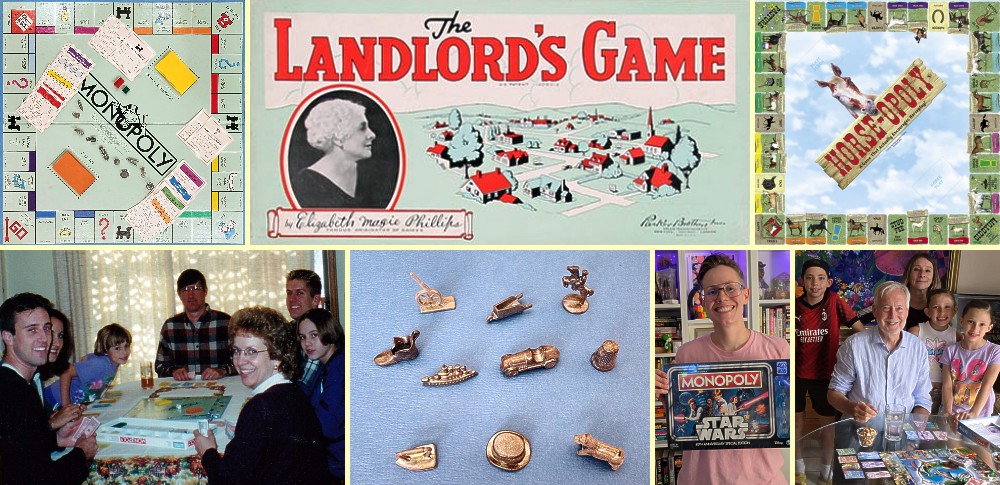
Monopoly got its inspiration from The Landlord's Game, designed in 1903 by Elizabeth "Lizzie" Magie, the daughter of an abolitionist.
She created it to show the dangers of monopolies and unequal wealth. In the 1920s, homemade copies of her game found their way to a
Quaker community in Atlantic City. The Quakers incorporated it into their teaching, making some modifications along the way.
A friend taught Pennsylvanian Charles Darrow how to play a version of this already-popular game. Darrow made his own design and secured
a patent in 1933. In 1935, he sold the rights to Parker Brothers. Monopoly went on to became the best-selling game in the country during
the Great Depression.
During World War II, Monopoly boards were used by fake charities to send escape maps, money, and messages to Allied prisoners in Nazi
camps. Games were permitted because guards believed prisoners would be less likely to cause trouble if they had something to do.
The game has appeared in more than 100 countries, and has been translated into more than 40 languages. In 1998, it was inducted into the
National Toy Hall of Fame. This past October, the Royal Mail in the United Kingdom issued stamps - including images of Old Kent Road and
Liverpool Street Station - to recognize the game's launch there 90 years ago.
The game also has spawned numerous special editions, such as Kansas-Opoly, Monopoly: Wicked Edition, Space-Opoly, Horse-Opoly, and others.
Husband Art's cousin Kris plays Horse-Opoly with her grandson Charlie.
The yellow cubes on some of the horse squares are hay bales. When you have 4, you can trade them in for a red barn ... Instead of
going to jail, the horse goes to the trailer. ... Tokens are horse related: a saddle, a trailer, a stable fly, etc. Instead of passing
"Go," you pass "Giddyup!" ...
Dave has several themed Monopoly sets, including James Bond 007, The Beatles, and Salina-Opoly, the latter being a nod to Salina, Kansas,
where he lives.
He said he always won when we played the game.
... my theory was buy as many properties as I could. I continued that as an adult player, but the game takes so long we seldom played
it with our boys. They didn't like me winning all the time. ... Great fun and perhaps buying property as a kid is what got me interested
in buying rentals as an adult, or maybe not!
Nephew Paul's main memory is his dad crushing him and his brother Michael every time they played. "He showed no mercy and it was always
so frustratingly fun because we could never win, but the challenge to try was great," he said.
Paul's wife Rachel said her first Monopoly memory is playing it at our home in 1999. She remembers our 7-year-old daughter Katie beating
her Uncle Dave - "who was trying to swindle her out of Park Place or Boardwalk."
"... I think most people and families really have such fun memories and traditions with it," Rachel said, "even going back to the player
piece everyone chooses. My brother liked the dog, I liked the shoe or the thimble ..."
Nephew Michael remembers the intensity.
Monopoly has been a game of survival in our family, ever since we were kids. Always. It's about as intense as it gets. Did we have
fun? Maybe. Did we crush our family into bankruptcy oblivion? Absolutely. Did we stop talking to each other for a while when the last
dollar was taken? That may have happened more than once.
Having a dad who was not just a career financial guy PLUS owned a bunch of property, we could barely get out of the game with a dollar
to our names.
Michael's wife Kristina also recalls the fervor.
My favorite Monopoly moment was when I was still NEW in the family, maybe just engaged to Michael. ... I beat Dustin ... and this dude
CRASHED OUT. Like slammed fists on the table, called BS and was close to flipping the board. ...
That's when I knew: these people take their games very seriously. You'd better know what family you're marrying into.
Many talk about how long it takes to play the game. Friend Bryce said he and his two brothers played it for hours over Christmas
vacations. "My mom would have to chase us out to do chores and milk cows ..."
Some mention the game's educational aspects for children, such as helping them learn reading and math skills.
But not everyone is a fan.
In the 1970s, San Francisco State University economics professor Ralph Anspach wanted to demonstrate that monopolies could be harmful
to a free-enterprise system. He produced a game, Bust the Trust, in 1973, but changed the name to Anti-Monopoly. In 1974, Parker
Brothers sued him over his use of the word "Monopoly," claiming trademark infringement. Anspach based his defense on the fact that
Lizzie Magie's game existed in the public domain before Parker bought it, thereby nullifying the company's claim. The case dragged on
for years, but Anspach and Parker reached a settlement, allowing him to use the Anti-Monopoly name. That game is still around as well.
The fact that Monopoly has been around for 90 years is quite a feat. But if someone says, "It's just a game," perhaps they should ask
my brother Dave's family!